"Warehouse robots" is a category wide enough to be almost useless as a buying term. It covers guided vehicles that follow a wire, shuttle fleets locked into fixed racking, gridded systems that stack bins without aisles, and free-navigating robots that pick inside the shelves you already own. These systems share a motor and a control layer and little else. This article compares them the way a buyer has to choose between them: by navigation, by what happens to the building, by how fast they go live, and by where each one genuinely fits.
The categories hiding under "warehouse robots"
Two questions separate almost every warehouse robot from every other: does it need fixed infrastructure to work, and does it navigate on a guided path or on its own. Answer those two and the market for warehouse robots sorts into a handful of reference architectures that behave nothing alike. They are all part of the same warehouse automation toolkit, but they are not interchangeable.
On the fixed-infrastructure side sit three storage systems. Crane-based automated small-parts storage (AS/RS) runs a rail-guided crane up and down a narrow aisle. Shuttle systems put a fleet of vehicles on rails inside every rack level, fed by vertical lifts. Cube storage drops the aisles entirely and stacks bins in an aluminium grid that robots work from above. All three deliver high density and throughput, and all three are built into the building.
On the no-infrastructure side sit the mobile robots, and here the dividing line is navigation. That split predates most of the current market, and it still decides whether a system can retrofit into a working warehouse.
AGV vs. AMR: the navigation split
An automated guided vehicle (AGV) follows fixed guidance - a wire in the floor, magnetic tape, reflectors, or painted lines. It runs a predefined route and stops when that route is blocked. Changing where it goes means changing the physical guidance. For stable, repetitive point-to-point transport, that is a reasonable trade.
An autonomous mobile robot (AMR) navigates with onboard sensors against a map it builds and maintains itself. It plans its own path, replans when an aisle is blocked, and drives around obstacles rather than waiting for them to clear. No floor infrastructure is required, and routes change in software. For the fuller treatment, see our glossary entry on the difference between AMR and AGV.
That one distinction decides retrofit feasibility. An existing warehouse is a moving environment of people, carts, and shifting stock. Guided vehicles want it to hold still; autonomous robots are built for the fact that it will not.
Fixed-infrastructure systems: shuttle, AS/RS, and cube storage
Shuttle systems are the throughput class of the fixed side. Vehicles run in parallel on rails across every rack level, vertical lifts move bins between levels, and the combination reaches the highest sustained throughput of any architecture here. The cost of that performance is structural: shuttle systems need purpose-built racking with integrated rails and lifts, which in practice means a new building or a major rebuild, a 12-36 month timeline, and a multi-million investment, often in the tens of millions.
Crane AS/RS and cube storage sit on the same side of the line for the same reason - both are built into the building - but tune the trade-off differently. AS/RS is the proven, long-lived choice for tall high-bay buildings with steady throughput. Cube storage reaches the highest storage density of any system by removing aisles and works in lower buildings, but it needs a fully cleared, load-bearing floor and locks you into standard bin sizes. Its modular grid goes up faster than a crane or shuttle installation, yet the total lead time lands in the same 12-36 month range once planning, approval, and clearing the floor are counted. None of the three runs alongside your current manual picking while it is being built.
Mobile picking robots (AMR / goods-to-person)
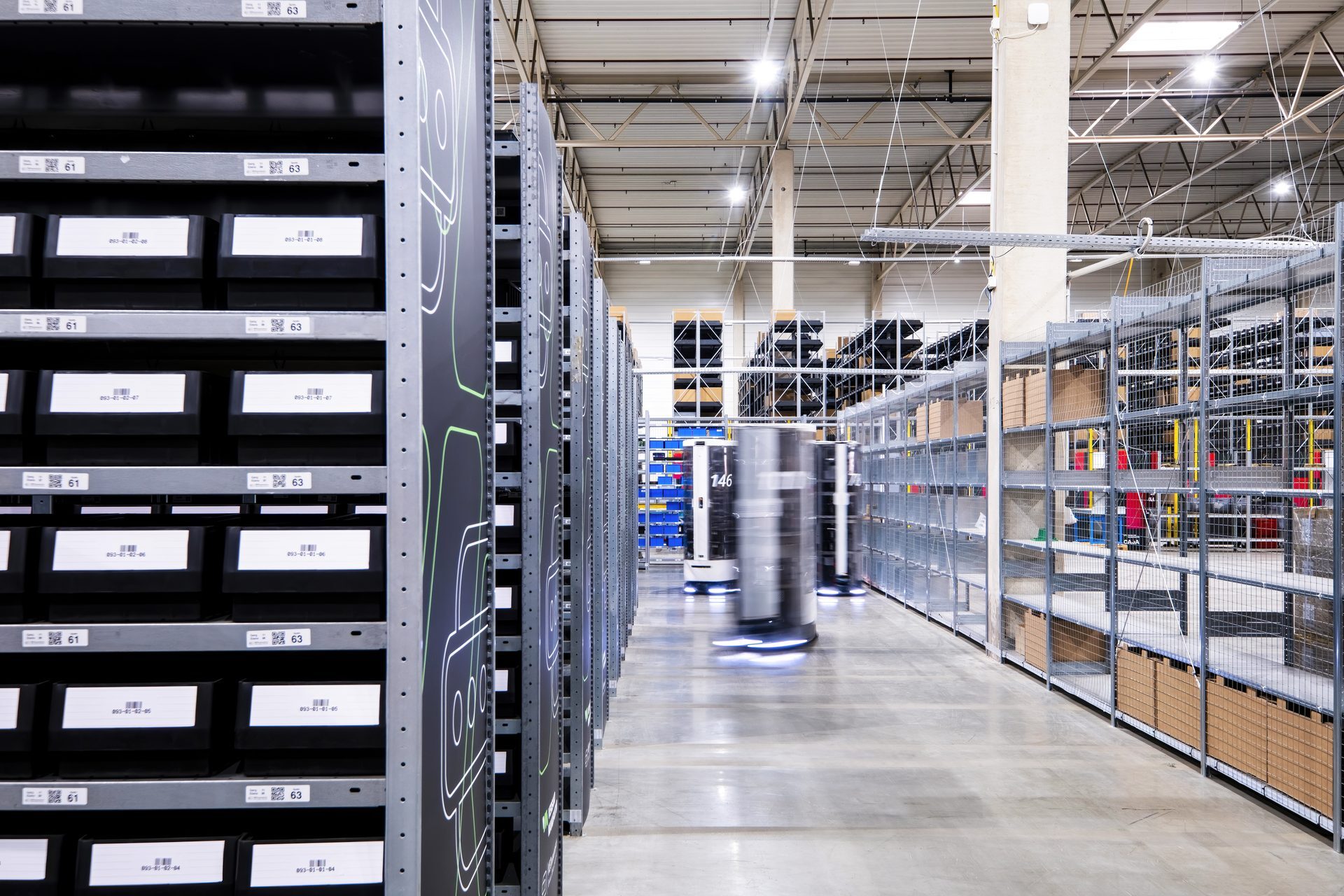
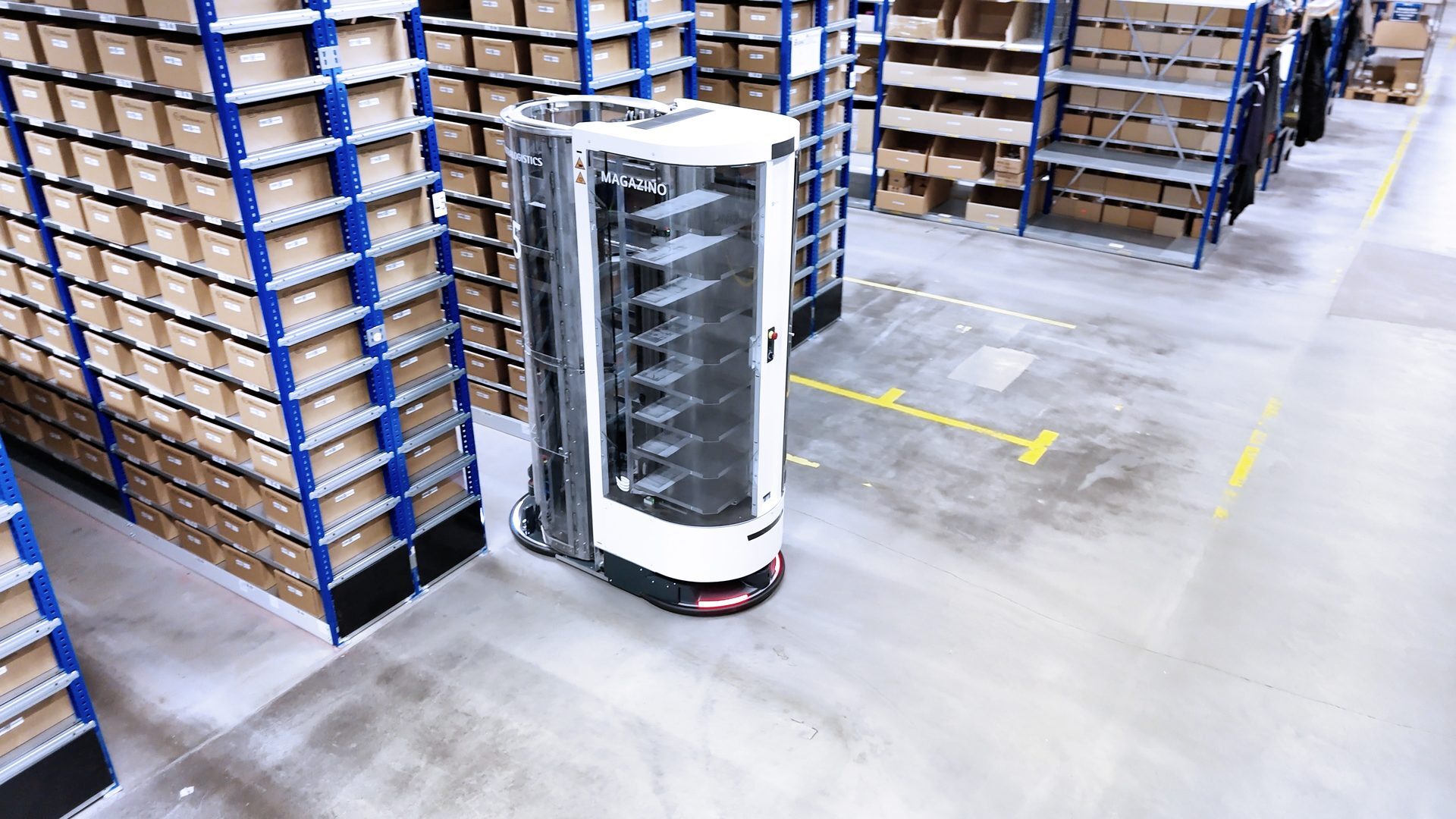
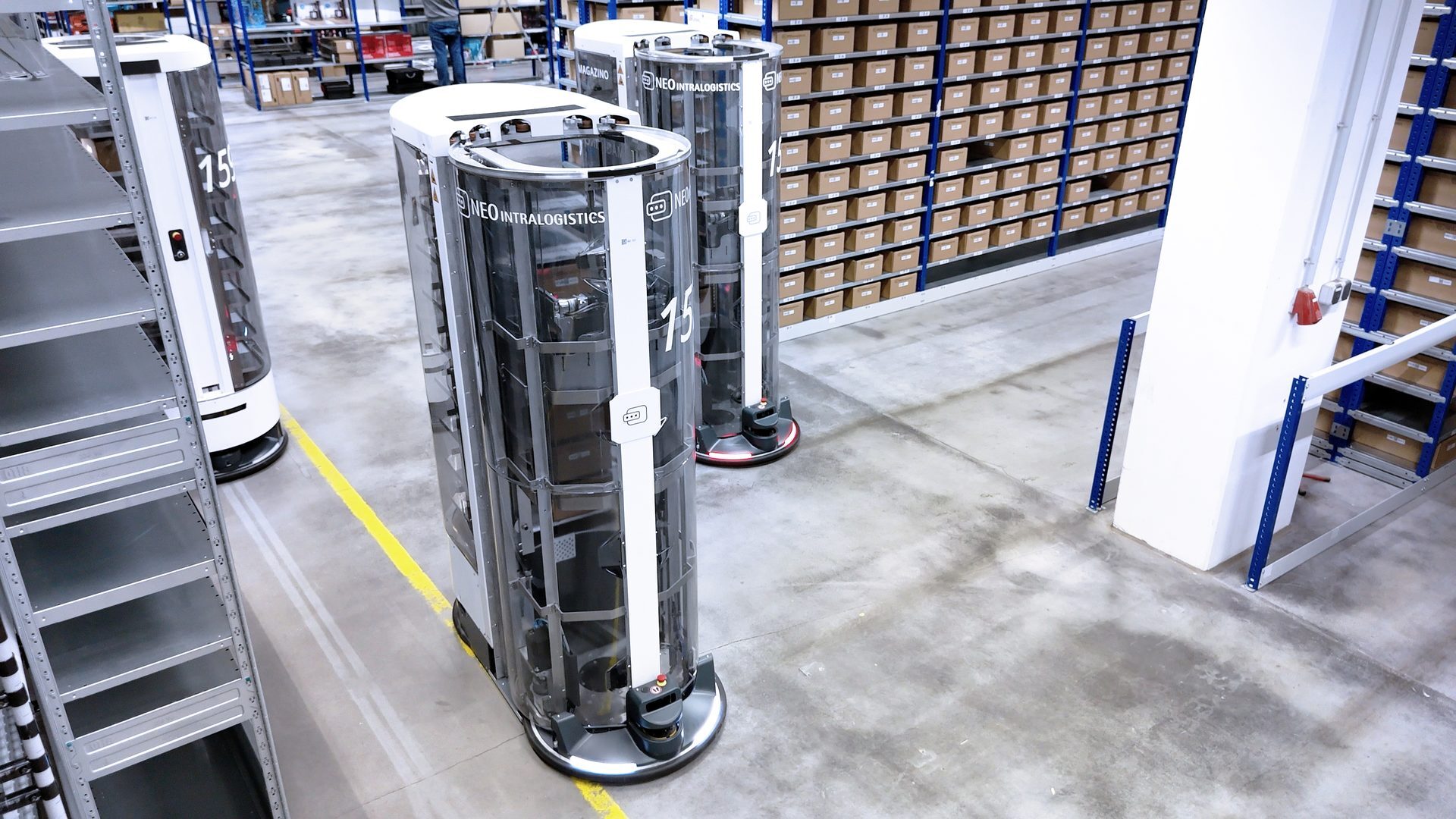
AMR-based goods-to-person systems are the one category that works without fixed infrastructure. The robots navigate the aisles of a warehouse as it stands, which is why they go live in 4-8 weeks rather than months or years, run in mixed operation with manual picking from day one, and are available on operating-cost pricing as well as capital purchase.
"AMR" is not one product, though. The category splits into three concepts that differ in what happens to your shelving and whether the picker ever stops walking - a distinction sharp enough that we give it its own article, AMR in the warehouse. For a cross-architecture comparison, the point that matters is the one all three share: mobile picking robots keep the building and the racks you already have, delivering the goods to a stationary goods-to-person station instead of rebuilding the storage around them.
Comparison: the criteria that decide the fit in an existing building
The useful question is rarely "which architecture is best" - it is "which one fits the building I am starting from". A system ideal for a greenfield distribution center can be structurally impossible in a running warehouse. The table lines up the categories on the criteria that decide the fit.
| Criterion | AGV | Shuttle | Crane AS/RS | Cube storage | AMR / goods-to-person |
|---|---|---|---|---|---|
| Navigation | Fixed guidance (wire, tape, reflectors) | Rail-bound, per level | Rail-guided crane, per aisle | Robots on a fixed grid | Free, sensor-based |
| Fixed infrastructure | Guidance in the floor | Racking, rails, lifts | Racking, rails, crane | Aluminium grid | None |
| Building type | Existing or new, guided path | New-build / high bay | New-build / high bay | Cleared, load-bearing floor | Existing building, racks stay |
| Implementation time | Weeks to months | 12-36 months | 12-36 months | 12-36 months | 4-8 weeks |
| Scaling | Add vehicles | Add shuttles (to lift limit) | New aisles (construction) | Add robots (to grid limit) | Add robots (no hard limit) |
| Failure behavior | Vehicle down, its route stalls | Shuttle down, throughput drops | Crane down, its aisle blocked | Robot down, throughput drops | Robot down, throughput drops |
| Storage density | Transport only | High (in tall buildings) | High (in tall buildings) | Highest | Medium |
| Mixed operation | Partial | No | No | Limited | Yes, from day one |
The rows are not equally weighted. In an existing building, two of them - fixed infrastructure and mixed operation - usually settle the shortlist before the rest are read.
Navigation and infrastructure
Guided and rail-bound systems buy performance with commitment. An AGV's route lives in the floor; a shuttle's throughput lives in the racking - excellent once installed, expensive to change afterwards. Free-navigating robots invert that: lower peak performance, but the layout lives in software, so a route change or a rack move is a configuration, not a construction project. If your product mix and volumes hold steady for a decade, the committed systems reward you; if they do not, the flexibility is worth more than the peak number.
Retrofit fit: what happens to your existing racking
This is the question that ends the most projects before they start. Most warehouses in Europe are existing buildings with standard shelf racking, not purpose-built automation halls, and the fixed architectures all need the floor cleared. Shuttle and AS/RS need their own racking; cube storage needs the shelves torn out and replaced with a grid. For an operator who has to keep shipping through the transition, "clear the floor first" is often a quiet no.
Mobile picking robots are the exception: they work in the racking already in place, which keeps a warehouse retrofit on the table for buildings where the fixed systems are ruled out on day one. If keeping your current racks is a hard requirement, it eliminates three of the five categories - shuttle, crane AS/RS, and cube storage - leaving only the AGV and the mobile picking robot.
Throughput vs. density vs. speed-to-live
These three pull against each other, and no architecture maximizes all of them. Fixed shuttle and cube systems win on density and sustained throughput - cube storage in particular reaches the highest storage density by removing aisles entirely, which is the core of the NEO versus cube storage trade-off - but they pay for it in build time and rebuild. Mobile robots win on speed-to-live and flexibility yet need aisles to drive in, so their density sits below a gridded system in the same footprint. Very high volumes expose the ceiling: above roughly 10,000 order lines per hour, the number of robots that can share an aisle becomes the limit, and the fixed high-throughput systems pull ahead. Decide which of the three you cannot compromise on before you talk to vendors, because that ranking, not a feature list, narrows the field.
Cost model: purchase, RaaS, or pay-per-pick
The financial model filters vendors as hard as the technology does. Fixed systems are capital-heavy and carry a long internal approval path: a multi-million request, often in the tens of millions, typically needs board sign-off, a formal business case, and months of process before anything is built. Mobile robots are the one category broadly available as an operating cost. Robotics-as-a-Service bundles hardware, software, and maintenance into a monthly fee; pay-per-pick charges a variable fee per completed pick, which rises in peak weeks and falls in quiet ones and needs no capital request at all. If a large capital ask would stall in your organization, the commercial model can shorten the vendor list before a single technical criterion is applied.
Common misconceptions when comparing warehouse robots
Three recurring assumptions send comparisons off course. First, "goods-to-person" on a datasheet does not always mean a stationary picker: some systems described that way still have the person walking the aisles with a robot in tow. Ask whether the picker stands at a station at the end of the shift or keeps moving. Second, "AMR" is not one system - it is three concepts with different infrastructure needs, so treating it as a single column in your vendor list flattens the differences that decide the project. Third, throughput figures from someone else's installation do not transfer: a rate quoted for one building assumes that building's order profile, station design, and traffic. Treat a published number as a ceiling to verify, not a promise.
Which architecture for which starting point
This assumes the prior question is settled. Whether robotic picking pays off against manual at all - throughput, cost per pick, warehouse fit - is answered in the comparison of robotic vs. manual picking; below roughly 5,000 picks a day, manual often stays the better answer.
From there the decision runs as an elimination, not a scoring exercise. Start from the constraints you cannot change and let each hard "no" remove a category:
- Existing building, racks staying, shipping cannot stop: mobile AMR / goods-to-person is usually the only category left, because the fixed systems need the floor cleared.
- New building, high bay, maximum density for standard bins, long timeline acceptable: shuttle or AS/RS earn the shortlist, and mobile robots would waste the height.
- Low or moderate ceiling, cleared floor available, density is the priority: cube storage fits its sweet spot.
- Point-to-point transport between fixed stations rather than picking: an AGV or an AMR transport fleet may be all you need.
One non-negotiable row - a timeline under three months, no capital budget, or racking that has to stay - is enough to rule a category out regardless of how well it scores everywhere else. Work the hard constraints first; the remaining choices are usually one or two, and that is where a detailed evaluation earns its cost. The first cut is almost always the same one: AMR or fixed automation - mobile robots in the building you have, or an installation the building has to be built around.
For a warehouse that fits the last-standing profile - existing shelving, a running operation, results needed this year - NEO retrofits picking into the racks already in place, reaching 70% less picking labor and 2-3× storage capacity with go-live in 6-8 weeks and no upfront investment.
Find the architecture that fits your building
Two steps save the most time when you are comparing architectures for an existing warehouse. Browse our resource library for the architecture, investment, and timeline comparisons in one place - our in-depth four-architecture comparison whitepaper (in German) covers the groundwork - or have us assess your building, your volumes, and the realistic automation path within days.