Request a Fit-Check

What Is Warehouse Automation?
Definition

Warehouse automation describes systems that take over physical or digital warehouse tasks that would otherwise be done by hand: moving goods, storing and retrieving them, assembling orders, and steering the work through software. It is a sub-field of intralogistics, which covers all material flows inside a site.

Automation is rarely all-or-nothing: most warehouses combine automated and manual zones, and the practical question is which process to automate, with which architecture, at what cost.

Types of warehouse automation

Warehouse automation technologies fall into several families, each suited to different operational requirements. They differ less in what they achieve than in what they require - most stationary systems need a new structure built around them:

  • Conveyor systems and sortation: Fixed belts and sorters move goods along set routes between warehouse zones and direct items to the correct packing or shipping lane. Best suited for high, stable volumes on fixed paths.
  • Crane-based AS/RS (Automated Storage and Retrieval Systems): Storage cranes or mini-load systems serve bins in high-bay racking. High throughput and storage density, but built for new buildings with 10-15 m hall height.
  • Shuttle systems: Rail-bound vehicles serve each racking level to deliver bins at high throughput. Scalable by adding more shuttles, but tied to a dedicated racking configuration.
  • Cube-based AS/RS: Bins stacked in a dense grid with robots operating on top. Delivers maximum storage density, but requires a purpose-built grid structure.
  • AGV (Automated Guided Vehicles): Vehicles follow fixed guidance - wires, magnetic strips, or floor markers - for repetitive point-to-point transport. Reliable but inflexible; layout changes require physical modifications.
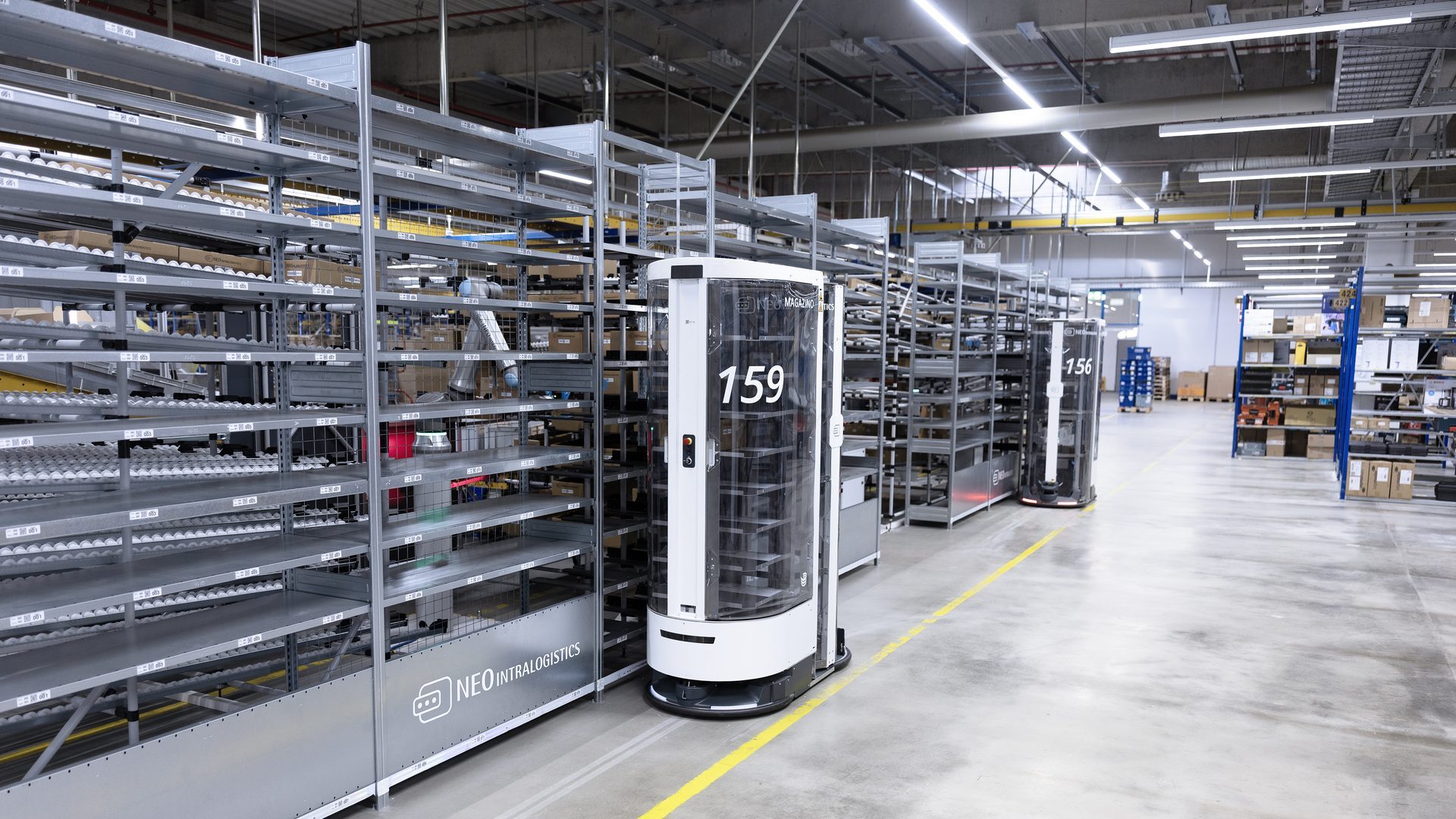
  • AMR (Autonomous Mobile Robots): Robots navigate freely by sensors and software, with no fixed infrastructure. More flexible than AGVs and suited to retrofit deployment in existing warehouses.
  • Robotic picking arms: Arms grasp individual items at a station, typically at goods-to-person stations alongside AMR or AS/RS systems.
Fleet of autonomous mobile robots operating across a warehouse floor

Benefits of warehouse automation

  • Higher storage density: Automated retrofits can achieve 2-3× the storage capacity of manual shelf warehouses through optimized shelf utilization - without new construction.
  • Higher throughput: Automated systems run continuously and consistently. Goods-to-person picking reaches 200-400+ picks per hour per station, against 60-120 picks per hour in manual operation.
  • Reduced error rates: Automated picking and verification reduce error rates from 0.1-0.3% (manual) to below 0.01%.
  • Lower labor dependency: Automation addresses the structural labor shortage in logistics by reducing the number of workers needed per unit of throughput.
  • Improved ergonomics: Removing repetitive walking, bending, and lifting from the workflow reduces injury risk and improves working conditions.
  • Scalability: Robotic fleets and modular systems can scale incrementally with demand, unlike manual labor which requires proportional headcount increases.
Challenges

  • Capital investment: Traditional automation (AS/RS, shuttles, conveyors) requires significant upfront investment - often reaching tens of millions - and 12-36 months from decision to operation.
  • Infrastructure requirements: Many systems require purpose-built facilities or substantial modifications to existing warehouses.
  • Integration complexity: Connecting automation with existing WMS, ERP, and operational workflows demands careful planning.
  • Flexibility: Dedicated infrastructure can become a constraint when product ranges, order profiles, or layouts change.

The trend toward retrofit automation

A growing segment of the industry automates within existing warehouse infrastructure - no new buildings, no racking replacements, no floor modifications. AMR-based goods-to-person systems are the main retrofit architecture, because free-navigating robots need no rails and no grid. That shortens deployment from months to weeks and opens automation to mid-sized warehouses that could not justify a greenfield project.

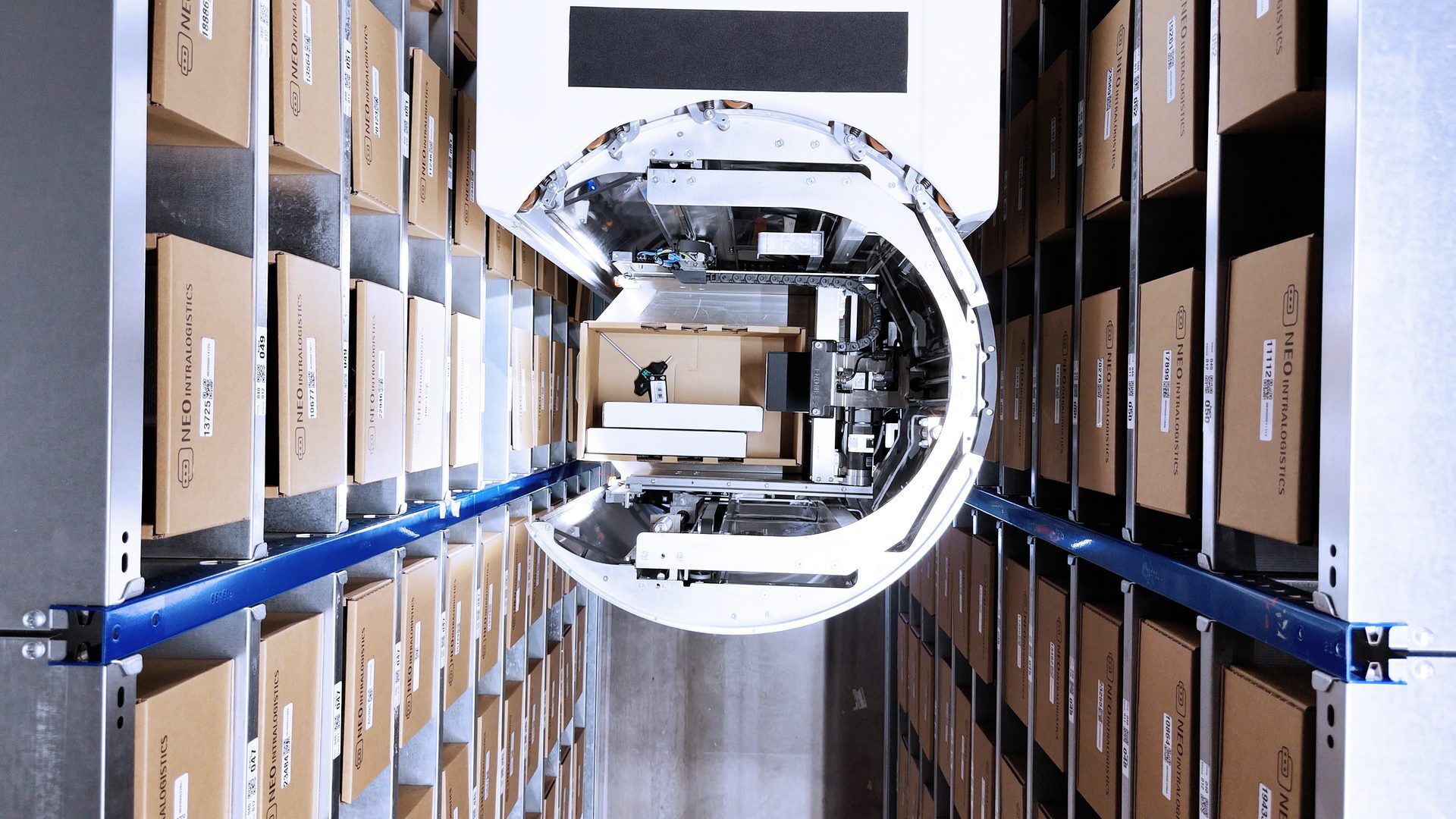
Close-up view of NEO:runner mechanism from below during bin retrieval

NEO’s approach to warehouse automation

NEOintralogistics delivers warehouse automation in existing shelf-based warehouses. A fleet of NEO:runner robots retrieves bins from standard shelving, a goods-to-person PickStation presents them to the picker, and NEO:os orchestrates the system alongside the existing WMS - no rails, no grid, no structural changes.

Go-live takes 6-8 weeks instead of the 12-36 months a classic build requires, and the pay-per-pick model replaces upfront investment with a price per completed pick. Deployments cut picking labor by 70% and raise storage capacity 2-3×.

Ready for the future of your warehouse?

See live how NEO automates your shelving warehouse - in our showroom in Bochum or via remote demo.

Request a Fit-Check