Automating spare parts and MRO warehouses without replacing the racking
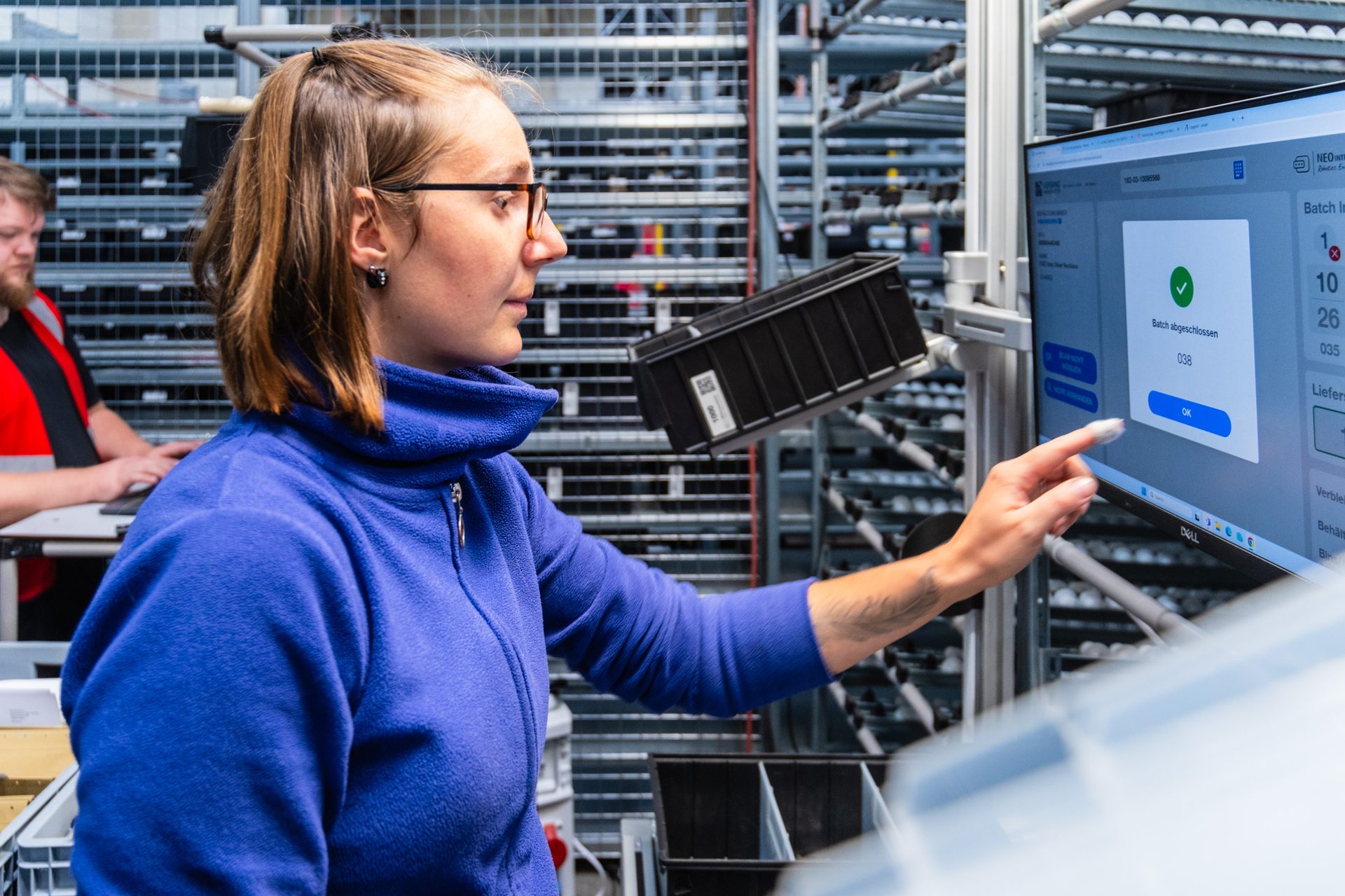
A spare parts warehouse carries a very large number of SKUs, each of them picked rarely. That is exactly where the walk to the item is longest and a mispick is most expensive. NEO brings the bins out of your existing shelving to a stationary station - no racking replacement, no shutdown, no upfront investment.
NEO automates spare parts and MRO warehouses inside existing shelf racking. Robots bring bins to a stationary picking station: 99.9% picking accuracy instead of a 0.1-0.3% manual error rate, 2-3× more items in the same footprint, live in 6-8 weeks with no racking teardown and no upfront investment.
Two use cases, one warehouse profile
Spare parts for external customers
OEM aftersales and parts distribution centers in machinery, agricultural equipment, automotive, aviation and medical technology; technical wholesalers and C-parts distributors. The part goes to a dealer, a workshop or an end customer. Aftersales is a profit center: a wrong or late part breaks a delivery commitment and stops your customer's machine.
Consumables and internal maintenance
Central maintenance stores at large operators in energy, rail, process industry and multi-site manufacturing. The part goes into your own maintenance, and the damage is your own downtime. A single plant store rarely reaches the volume threshold, though - this case usually qualifies only when centralized, with one store supplying many sites.
What makes a spare parts warehouse expensive
The walk to the item, not the number of picks
In a slow-mover warehouse, travel per pick is at its worst. The 10-16 km per shift do not come from many picks but from long distances between them. An order with three lines can mean three aisles.
A mispick costs downtime, not a return
At a 0.1-0.3% error rate in manual picking, it will predictably hit the customer whose machine is standing still. In the parts business that is the most expensive error in the whole assortment.
The floor is full, the assortment keeps growing
Every new machine generation adds SKUs, and discontinued parts still have to be stocked. Inventory grows into a building that does not grow with it.
Demand is not seasonal, it is random
A machine fails when it fails. Capacity cannot be planned around peaks the way retail does - and aftersales carries the margin but is rarely run with an automation budget of its own.
In this segment, accuracy is the first argument
In most warehouses, automation sells on labor cost. Not in a spare parts warehouse. Here a mispick costs the customer the downtime of their machine, not the return shipping of a parcel.
NEO picks at 99.9% accuracy with an error rate below 0.01%. Manual picking sits at 0.1-0.3%. The difference sounds small and is not: it decides how often a year a customer receives the wrong part and then waits the same time again.
The picker is handed the right bin at the station instead of searching for it in the racking. Mix-ups between visually similar part numbers - the norm rather than the exception in a parts assortment - happen exactly where someone stands in front of a full shelf and reaches for the right box.
Density before throughput: the real problem in a slow-mover warehouse
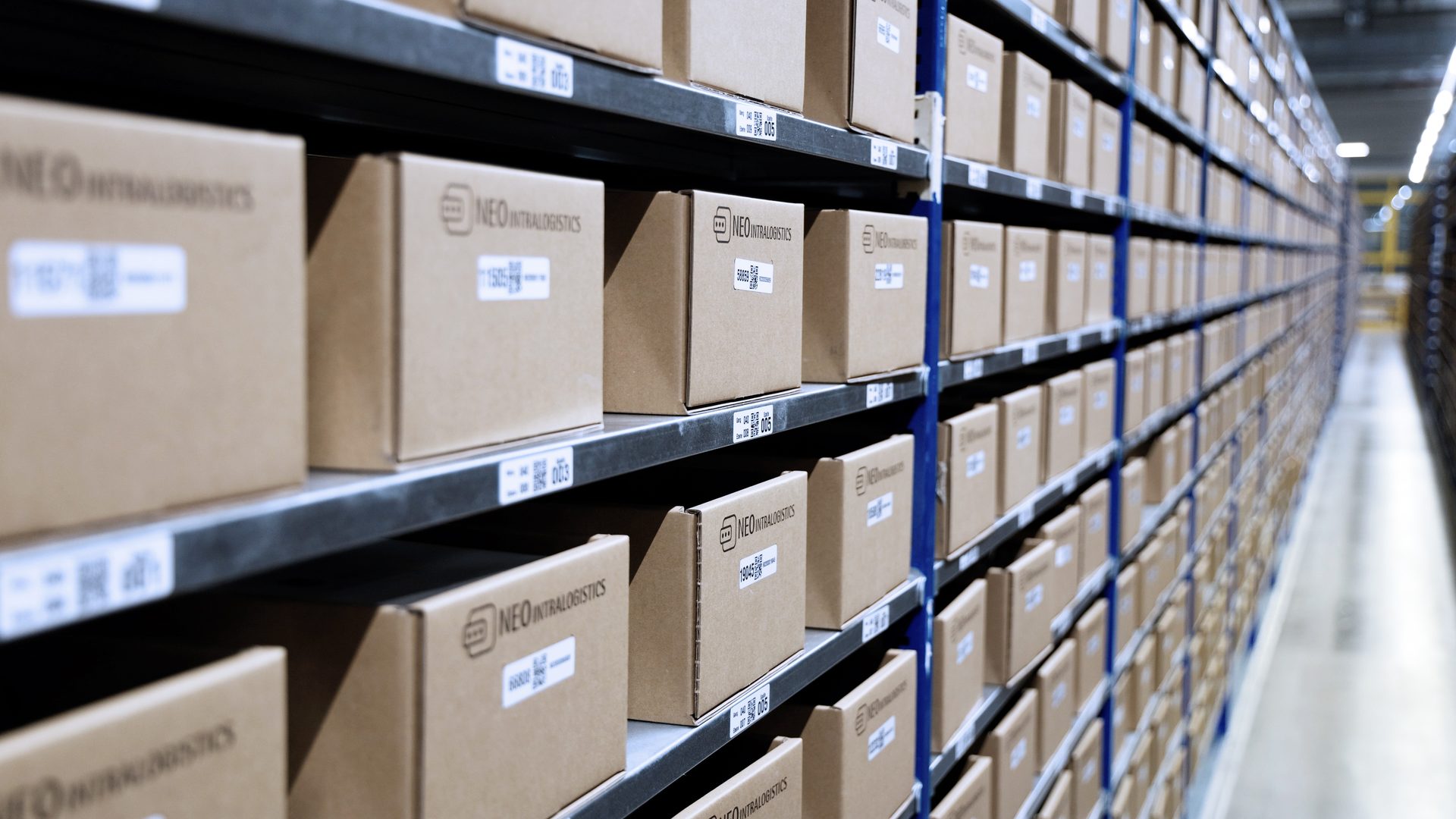
In parts assortments, throughput is rarely the bottleneck - floor space is. The assortment grows, the building does not. NEO densifies storage inside the existing racking and creates 2-3× more storage capacity in the same footprint - no extension, no new building.
At the same time, goods-to-person inverts exactly the metric that is worst in a slow-mover warehouse. Instead of 60-120 picks per hour in a manual shelf-based warehouse, one station reaches 400 picks per hour, because the travel between positions disappears. The robot walks, not the person.
Slow movers are the normal case in this system. Precisely where an item is not touched for weeks, the density gain works hardest - it costs no extra travel.
Retrofit during live operation - availability is the product
Spare parts warehouses have grown historically and cannot be shut down for a construction phase. Four weeks without deliveries costs the delivery commitment the service contract is built on.
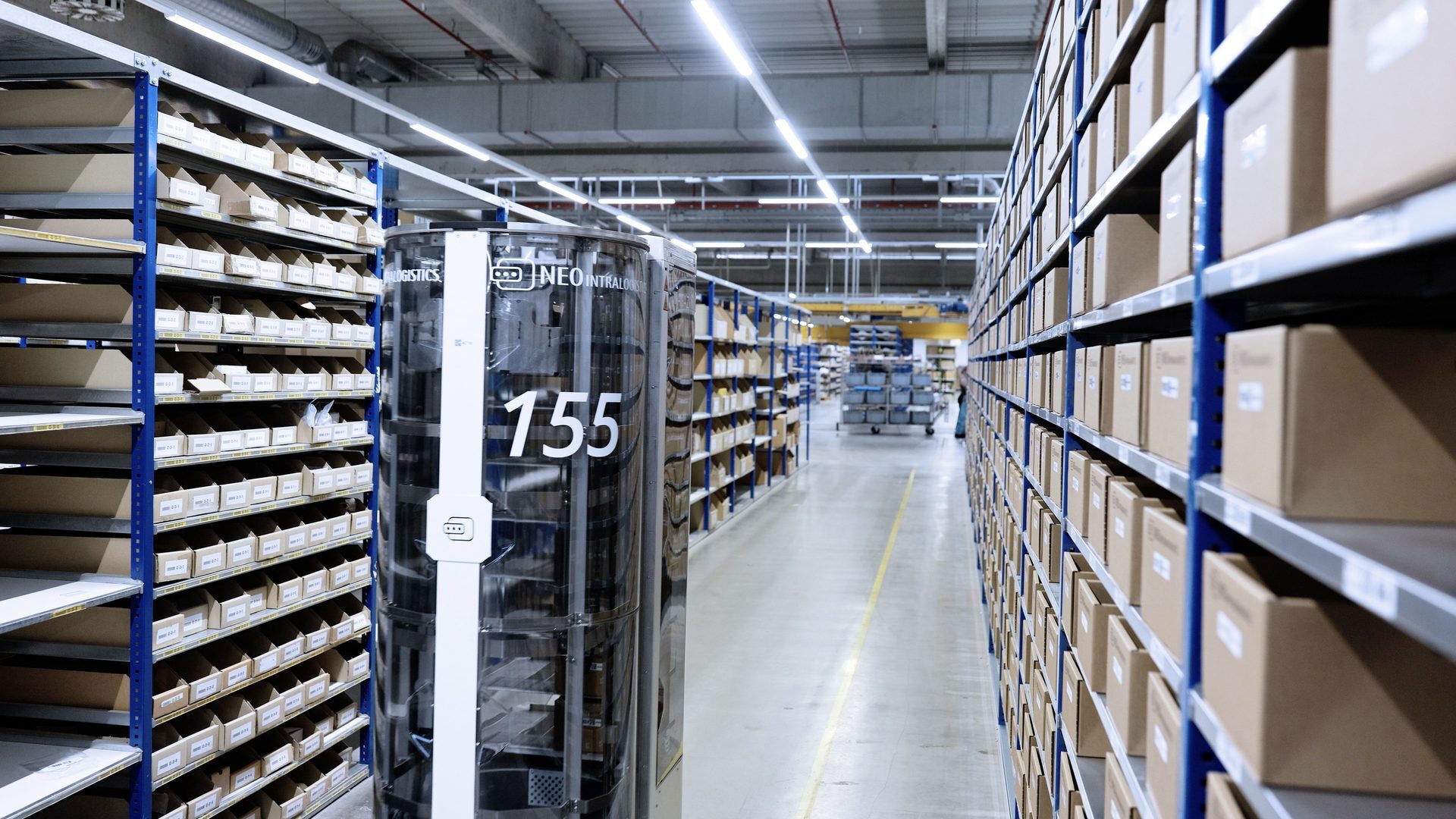
NEO therefore works inside the existing shelf racking: no teardown, no new storage infrastructure. The only structural work is the picking station with its power and data connections. The items in the automated area are repacked into NEO bins; this happens area by area during live operation. From decision to first automated pick, 6-8 weeks pass while the rest of the warehouse keeps running undisturbed.
For a buying committee that is a risk argument more than a speed argument: the automated area is bounded, the way back stays open, and a pilot is easier to approve in a corporate organization than a full project. The connection to your WMS runs over standard interfaces and typically takes 10-15 IT development days across about four weeks. Your WMS stays the system of record.
How the retrofit worksWhat an automated parts area delivers
How a rollout runs
A bounded area first, scaling afterwards. Every stage can be approved on its own.
Assessment and scoping of the pilot area
We check aisle widths, shelf heights, bin dimensions and above all the actual pick count in the small-parts area. The result is a clearly bounded area with a solid volume basis - and an honest answer if the numbers do not hold up.
WMS integration and installation
The connection runs over standard interfaces, typically 10-15 IT development days across about four weeks. Your WMS stays the system of record. Robots and station are installed during live operation while the rest of the warehouse keeps working.
Go-live in the bounded area
After 6-8 weeks the automated area is running. Pickers work stationary at the station, the remaining areas stay manual. The boundary between the two is configurable in software.
Scaling on operational data
Additional stations and robots follow once the operational data justifies them - up to 100,000 picks per day per system. That decision rests on real picks from your warehouse, not on a projection.
Technical requirements
Check upfront whether your small-parts area meets the minimum requirements. The decisive row is pick volume - not SKU count.
| Racking system | Standard shelf racking | existing racking, no special racking |
| Aisle width | from 85 cm | |
| Shelf height | up to 250 cm | upper levels stay manual |
| Item size | max. 380 × 270 × 140 mm | L × W × H |
| Item weight | max. 5 kg | |
| Pick volume | from 5,000 picks/day | in the small-parts area, not the whole warehouse |
| System ceiling | up to 100,000 picks/day | per system, via additional stations |
| WMS integration | 10-15 IT development days | across approx. 4 weeks, your WMS stays leading |
| Stocking | Items are repacked into NEO bins | area by area during live operation, no racking teardown |
NEO fits spare parts warehouses that:
- Run a small-parts assortment in shelf racking that generates more than 5,000 picks per day
- Treat delivery reliability and picking accuracy as the hardest metric
- Need to fit more SKUs into the same footprint
- Cannot be shut down for a conversion
- Want to run automation as an operating expense rather than a capital request
- Prefer to start with a bounded area and decide afterwards
When NEO does not fit:
- Large or heavy parts: above 380 × 270 × 140 mm or above 5 kg stay manual
- Many SKUs but few picks - 80,000 SKUs do not qualify, 5,000 picks per day do
- Pure pallet storage, long goods or high-bay without a shelf-racking area
- Aisle widths below 85 cm
- Single-plant maintenance stores without centralized volume
Frequently asked questions
We have 80,000 SKUs but only a few picks a day. Does that fit?
Probably not - and we would rather say so now than during the project. Qualification runs on the number of picks in the small-parts area, not on SKU count. A warehouse with a very broad assortment can sit well below 5,000 picks per day, and then automation does not pay off. A high SKU count indicates density and search problems, but it is not a qualification criterion in itself.
Part of our assortment is too large or too heavy. Does it still work?
Yes, as partial-area automation. NEO covers items up to 380 × 270 × 140 mm and 5 kg. In a parts assortment a considerable share regularly sits above that - and stays manual. Small parts and large parts become separate processes running in parallel in the same warehouse. That is exactly what keeps the rest of the warehouse undisturbed.
How fast is a part at the dock after the order arrives?
That depends on your process after the pick - packing, dispatch cut-off, carrier. What changes is the part before it: instead of a picker walking to the racking and searching for the right box, the bin comes to the station. One station handles 400 picks per hour against 60-120 in a manual shelf-based warehouse. A universal per-order figure in minutes would be invented; we do the concrete calculation in the Fit-Check with your numbers.
What about discontinued parts we have to keep in stock?
They are the normal case in this system, not the exception. Slow movers cost no extra travel in the automated area, because nobody walks to them anyway. The 2-3× density gain works hardest on items that move rarely, because they can be stored densely without worsening access time.
Can we start with one area and expand later?
That is the recommended path. The start is one station with a bounded racking area. Scaling runs through additional stations and robots, up to 100,000 picks per day per system. Because NEO bills on a pay-per-pick basis, there is no capital request covering the full final stage, and the decision on the next stage rests on operational data from your own warehouse.
Does your small-parts area support automation?
In a Fit-Check we review your pick counts, your item spectrum and your racking situation - and we tell you when the numbers do not hold up. No commitment, with a clear assessment.
See NEO in actionRelated content
Goods-to-person: the robot walks, not the person
How the picking station works and why travel is the real cost block.
Pay-per-pick: automation as an operating expense
Why no capital request is needed and how billing per pick works.
Platform overview
How NEO:os, the robot fleet and the station work together.