Every AMR vendor datasheet uses the same words: autonomous, goods-to-person, fast to deploy, scalable. Behind those words sit three architectures that share little beyond a battery and a navigation stack - and picking the wrong one for your warehouse is an expensive mistake. This article separates AMRs from AGVs, breaks the AMR category into its three concepts for shelf-based warehouses, and walks through the comparison dimensions that actually decide the fit.
The momentum behind mobile robotics is not in dispute. Adoption is broad and still accelerating across warehousing, and mobile goods-to-person has emerged as a distinct category in its own right - a sign that the segment has outgrown the single "AMR" label.
The harder question for a warehouse operator is no longer whether mobile robotics makes sense. It is which mobile robotics - and that question cannot be answered from a datasheet.
What an AMR is - and what it is not
The oldest confusion in the category is the line between AMRs and AGVs, and it still shapes buying conversations today.
An automated guided vehicle (AGV) follows fixed guidance: wire in the floor, magnetic tape, reflectors, or painted lines. It drives a predefined route, and when something blocks that route, it stops and waits. Changing the route means changing the physical infrastructure. AGVs have moved pallets through factories for decades, and for stable point-to-point transport they remain a reasonable choice.
An autonomous mobile robot (AMR) navigates with onboard sensors - typically LiDAR, cameras, or both - against a map it builds and maintains itself. It plans its own path, replans when an aisle is blocked, and drives around obstacles instead of waiting for them to move. No floor infrastructure is required, and routes change in software, not in concrete.
| Criterion | AGV | AMR |
|---|---|---|
| Navigation | Fixed guidance (wire, tape, reflectors) | Sensor-based, free navigation on a self-maintained map |
| Reaction to obstacles | Stops and waits | Replans and drives around |
| Route changes | Physical infrastructure change | Software configuration |
| Floor preparation | Guidance installation required | None beyond a normal industrial floor |
| Typical role | Repetitive point-to-point transport | Dynamic transport and picking workflows |
That distinction matters for one practical reason: an existing warehouse full of people, carts, and shifting inventory is a dynamic environment. AGVs want that environment to hold still. AMRs are built for the fact that it will not.
What the AGV-versus-AMR distinction does not tell you is what the robot actually does for your picking operation. "AMR" describes how a machine navigates, not what workflow it automates - and that is where the label starts to mislead.
Three AMR concepts in shelf-based warehouses
Read a handful of AMR vendor documents side by side and you will find near-identical vocabulary describing fundamentally different systems. For shelf-based warehouses, three concepts dominate, and they differ in hardware, in what happens to your existing racking, in the role of the picker, and in the commercial model. A vendor comparison that treats them as one category flattens exactly the differences that decide project success.
Concept 1: Mobile shelf units driven to the picker
In the first concept, flat lifting robots drive underneath purpose-built mobile shelf units, raise them a few centimeters, and carry the entire unit to a picking station at the edge of the robotics area. The picker stays at the station; whole shelves come and go. Fleet software continuously reorganizes the grid, moving high-demand shelf units closer to the stations.
The productivity per workstation is the highest in the AMR category, because the picker performs no movement that does not add value. The constraint is equally structural: the system requires its own mobile shelf units. Existing shelving cannot be reused - the geometry, load paths, and docking points are different. Deploying this concept in an existing warehouse means dismantling the current racks in the automated zone, repacking the goods into the vendor's units, and preparing the floor and navigation grid. Mixed operation with manual picking in the same area is not possible. For a greenfield site designed around the system, none of this is a problem. For a running warehouse, it is less a retrofit than a rebuild.
Concept 2: Picking-assist robots in the aisle
The second concept inverts the logic. Instead of bringing shelves to the picker, a mobile bin carrier navigates to a pick location in the existing aisles and waits there for a picker. The person takes the item from the unchanged shelf, places it in the robot's tote, confirms - and the robot drives on to its next stop while the picker moves to the nearest waiting robot. Completed orders drive themselves to packing.
The intervention in the warehouse is minimal: shelving stays, floors stay, and pilot deployments regularly go productive within weeks. Walking distance drops substantially because the robot replaces the picking cart and the searching, and the guided sequence shortens the paths between picks. But the picker remains mobile. In a manual shelf-based operation, pickers cover 10-16 km per shift; a picking-assist deployment reduces that figure without eliminating it. Strictly speaking, this is a person-to-goods system with robot assistance - a meaningful ergonomic improvement, not a stationary workstation.
Concept 3: Bin-to-person from existing shelving
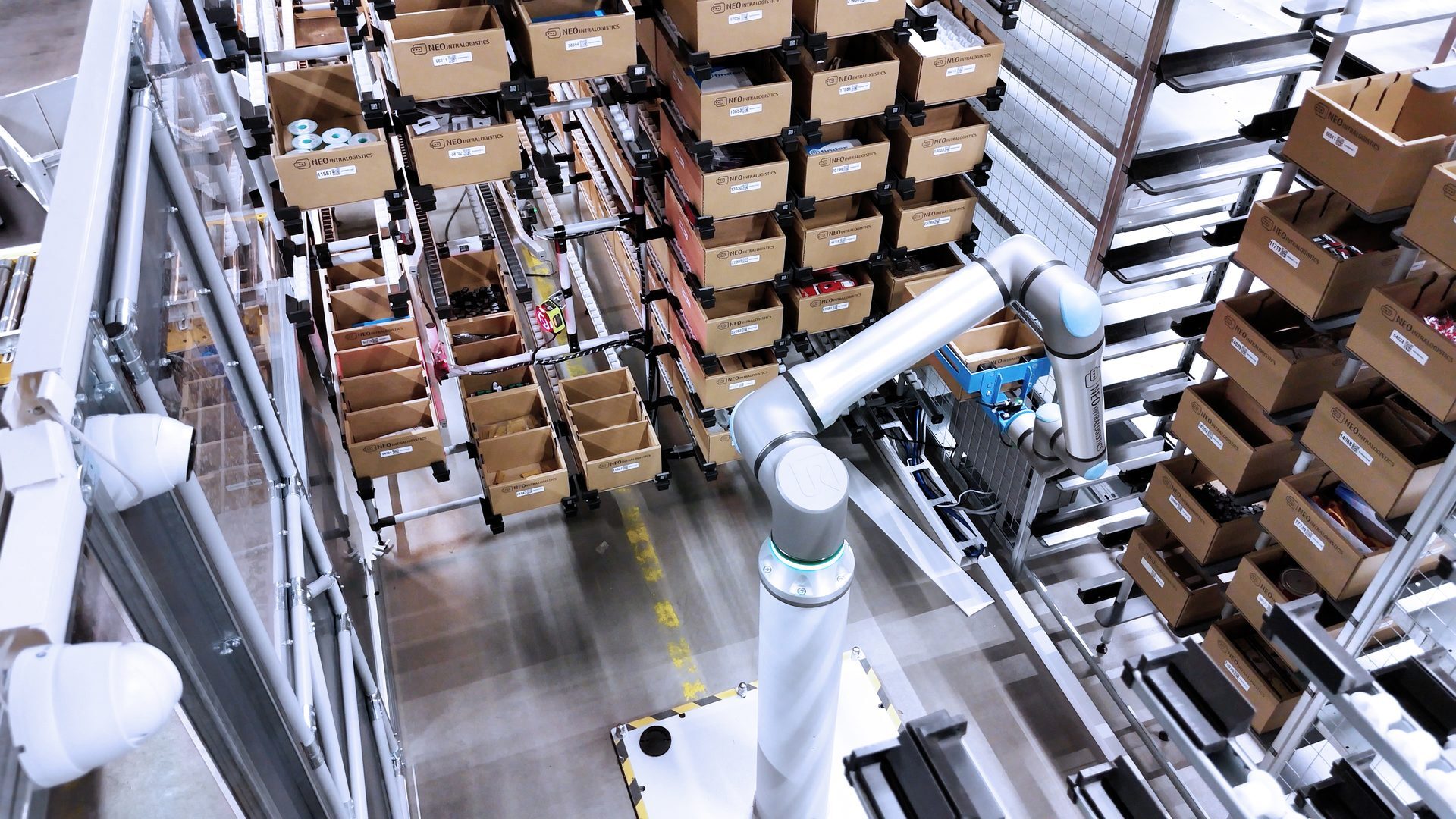
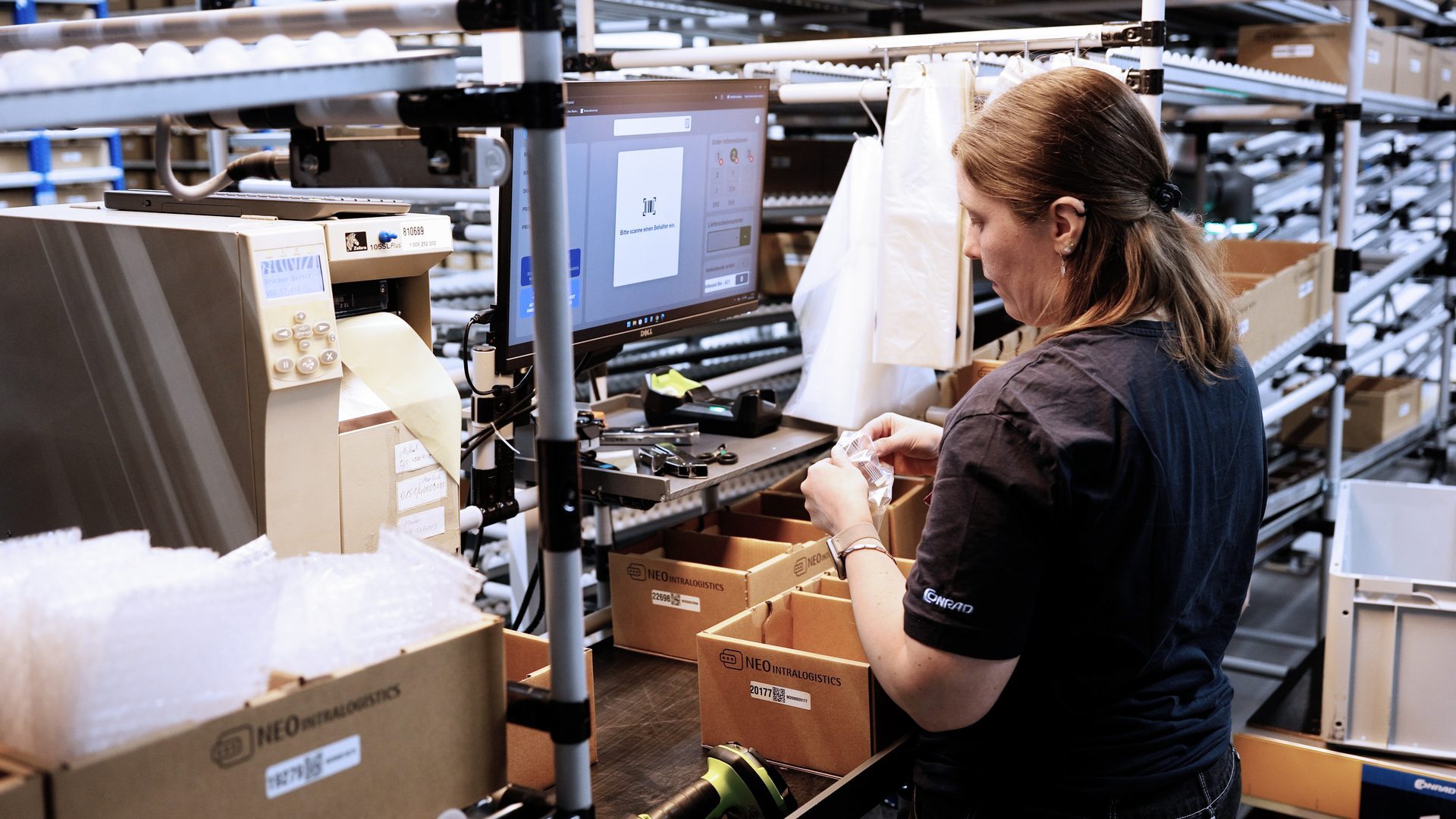
The third and youngest concept combines the two properties that the first two concepts each deliver only one of: a fully stationary picking workstation and unchanged existing shelving. A specialized mobile robot drives into the aisles of the existing shelf-based racking, retrieves individual bins directly from the shelf bays across the full usable rack height, carries them to a stationary goods-to-person station, and returns them after picking. The picker stands at one station for the whole shift while the warehouse does the walking.
Because the racking is untouched, mixed operation works from day one: some shelf rows are served by robots, others continue manually, and the boundary is a software setting that shifts as the rollout progresses. This is the concept behind the NEO platform, which deploys it in existing shelf-based warehouses with go-live in 6-8 weeks, including roughly 4 weeks of WMS integration. It is also the concept where pay-per-pick pricing is structurally at home, because completed picks can be metered and billed as a variable operating cost.
The limits deserve equal clarity. A bin-retrieval system works with bin-sized goods, not pallets or bulky items. It does not reach the storage density of a gridded cube system that eliminates aisles entirely. And it is the youngest of the three concepts, with a smaller installed base than the two older ones - growing, but shorter on decade-long reference installations.
The comparison dimensions that decide the fit
Once the three concepts are separated, the comparison stops being about brands and starts being about structure. Five dimensions carry most of the decision weight.
| Dimension | Mobile shelf units | Picking-assist in aisle | Bin-to-person from existing shelving |
|---|---|---|---|
| Picker during the shift | Stationary at station | Mobile, guided by robots | Stationary at station |
| Existing shelving | Replaced by vendor's mobile units | Unchanged | Unchanged |
| Mixed operation in same area | Not possible | Yes, from day one | Yes, from day one |
| Typical implementation | Several months incl. rack conversion | Weeks | Weeks, incl. station installation |
| Typical commercial models | CapEx, RaaS | RaaS, CapEx | Pay-per-pick, RaaS |
Throughput
Manual person-to-goods picking in shelf-based warehouses runs at 60-120 picks per hour. Goods-to-person systems reach 200-400+ picks per hour per station, industry-wide, depending on order structure and station design. The two stationary concepts operate in that G2P range; picking-assist deployments improve on manual rates without reaching it, because the human is still the moving part.
Ergonomics
Stationary picking removes walking, cart-pushing, and reaching across shelf heights, and replaces them with a defined grab zone. Picking-assist removes the cart and the searching but keeps the picker walking. Which improvement matters more depends on your workforce - more on that below.
Integration effort
All three concepts need a connection to the existing WMS, and in all three cases the software layer is where projects succeed or stall. The structural difference is elsewhere: the mobile-shelf concept adds rack conversion, goods repacking, and floor preparation on top of the IT work. The two retrofit-friendly concepts confine the project to software integration plus hardware delivery.
Scalability
Each concept scales along a different axis and hits a different ceiling. Mobile-shelf systems scale smoothly inside their grid and stop at its edge. Picking-assist fleets scale by adding robots until aisle traffic becomes the bottleneck - a physical limit that software can manage but not remove. Bin-to-person systems scale on two levers, robots and stations: add robots until station capacity is reached, then add a station, which needs floor space, power, and network rather than construction.
Commercial model
CapEx purchase exists across all three concepts. Robotics-as-a-Service, a monthly fee covering hardware, software, and maintenance, is broadly available. Pay-per-pick - a variable fee per completed pick, with costs that rise in peak weeks and fall in quiet ones - is currently concentrated in the bin-to-person segment. For operations where a large capital request would stall in the approval process, the commercial model can filter the vendor list before any technical criterion is applied.
Where AMRs fit - and where fixed automation wins
AMRs did not replace fixed automation; they occupy a different position in the trade-off space.
Fixed systems - shuttle systems, miniload AS/RS, cube-based AS/RS - deliver higher storage density and very high sustained throughput. The price is structural: a multi-million investment, often in the tens of millions, 12-36 months of implementation with a construction phase, and a facility that is committed to the system for its depreciation life. For a new distribution center designed around known long-term volumes, that trade can be rational. The detailed comparison lives in our NEO versus shuttle systems breakdown.
AMR concepts trade peak density for speed and reversibility. The two retrofit-friendly variants deploy in weeks rather than years, require no construction, and scale in increments instead of in one sizing decision made years before the demand materializes. In existing shelf-based warehouses, bin-to-person retrofits reach 2-3× storage capacity compared to the manual baseline and cut picking labor by 70% - without touching the building.
The honest summary: if you are building new, have stable volume forecasts, and need maximum density, fixed automation deserves the shortlist. If you have a running shelf-based warehouse, cannot stop shipping, and need results this year rather than in three, the AMR category is where your realistic options are - provided you pick the right concept within it.
Common misconceptions about AMRs
Most evaluation mistakes in this category trace back to one mechanism: a property of one AMR concept gets presented as a property of the whole category. Five examples recur.
"AMR means goods-to-person"
Only two of the three concepts give the picker a stationary workstation. Picking-assist systems are often described with goods-to-person language because the cart disappears, but the picker keeps walking. Ask every vendor one concrete question: at the end of the rollout, does the picker stand at a station, or move through the aisles?
"AMRs need no infrastructure"
True for the two concepts that reuse existing shelving. Not true for mobile-shelf systems, which replace the racking in the automated zone with their own units. Ask whether your current racks stay - in the first conversation, not during detailed planning.
"All AMRs deploy equally fast"
The spread across the three concepts is roughly a factor of three. Retrofit-friendly variants go productive in weeks; a mobile-shelf rollout with rack conversion takes months. If your deadline is the next peak season, ask for the implementation timeline of the specific concept, not the category average.
"AMRs scale without limits"
Adding robots is easy - until aisle traffic, grid capacity, or station capacity becomes the constraint. Every concept has a ceiling; they just sit in different places. Ask for a traffic and capacity statement for your target fleet size, not your pilot size.
"Pay-per-pick is available everywhere"
Variable per-pick pricing is currently concentrated in the bin-to-person segment. If your CFO logic requires OpEx instead of a capital request, apply that filter first - it shortens the vendor list faster than any technical criterion.
Ergonomics and acceptance: the factor that decides rollouts
Technical comparisons systematically underweight the human side, and yet adoption is where AMR projects most often quietly fail.
The move to stationary picking changes who can do the job. A goods-to-person station does not require the walking endurance of a classic picking shift, which opens the role to employees who could not work in picking before - for orthopedic reasons, during reintegration after illness, or due to age. In a labor market where every additional employable person counts, that is a benefit in its own right, separate from any productivity number.
Stationary work brings its own load profile: standing in one place, high repetition, a rhythm set by the system. None of this is a problem if shift planning treats the station as a new kind of workplace - rotation between stations and tasks, planned micro-breaks - rather than mapping the old tour logic onto it unchanged. At the station itself, grab heights, lighting, and visual guidance decide whether the workplace holds up over weeks, not the brochure.
Two organizational observations from real rollouts are worth taking seriously. First, acceptance is decided in the first fourteen days: project owners present on the floor, honest handling of teething problems, and visible recognition for the first operators shape the workforce's verdict for months. Second, for operations in Germany and Austria, works-council co-determination applies to every AMR variant, because these systems record performance-related data. Involving the works council during evaluation, not after the vendor decision, converts a project risk into a structured process.
For a deeper look at how robotic picking changes the workstation itself and the fulfillment workflow around it, see our article on robotic picking systems in fulfillment.
Find out which AMR concept fits your warehouse
If you are comparing AMR options for an existing shelf-based warehouse, two steps save the most time. Download our whitepaper comparing the three AMR concepts in depth (in German) for the full comparison groundwork - or book a free call and get an assessment of your warehouse, your volumes, and the realistic automation path within days.