Most warehouse automation projects that go wrong do not fail because the robots break. They fail because of decisions made before the contract was signed - the wrong comparison basis, a business model chosen too late, a system sized for a volume that never arrives. The technology usually works. The evaluation around it is where the money is lost.
The most expensive mistakes in a warehouse automation project are not made on the shop floor. They are made in the assumptions before it - long before a purchase order exists. A system can hit every specification on its data sheet and still be judged a failure, because the business case it was measured against was wrong from the start, or because the approval it needed never came.
Six decision and procurement patterns account for most of these outcomes. None is about a robot that cannot pick; each upsets the business case, the timeline, or the internal approval, and each is avoidable if you look for it before you sign. This piece walks through all six and the counter-move they share. It is a companion to our article on the warehouse automation challenges that keep projects from starting at all; this one is about projects that started and then derailed.
What "failure" actually means
The first is the project that never launches - it dies in the budget round, a CapEx sign-off that circulates for months and quietly expires. The second launches and slips: go-live moves by quarters, integration work no one scoped balloons, and the cost per pick that justified the exercise arrives late or not at all. The third goes live on time and underdelivers against the throughput it promised.
Only the third looks like a technology problem, and even there the cause is usually a mismatch between what was demonstrated and what was contracted. The other two are decided in evaluation and procurement - which is where you have the most influence, and where the six patterns below live.
Failure 1: The wrong comparison basis
The most common costing error is to price an automation offer against the bare hourly wage of a picker. It makes almost any serious offer look expensive, and it rejects offers that would genuinely relieve the site.
The bare wage is not what a manual pick costs. Order picking is the most labor-intensive activity in most warehouses - its cost has been estimated at as much as 55% of total warehouse operating expense (De Koster et al., 2007, drawing on Tompkins et al.), and roughly half of a picker's time goes not to picking but to travelling between locations. The fully loaded cost per pick includes that travel time, plus shift premiums, temp-labor markups, turnover, error correction, and the indirect load of workwear, break rooms, onboarding, and sick-cover a departing worker takes with them.
Priced against that number, the same offer often lands far closer than the hourly-wage comparison suggested. Cost per pick is the only basis that holds across business models, because it compares like with like. Before you compare any two offers, agree on what a pick actually costs you today - fully loaded, not the wage line.
Failure 2: Deciding the business model too late
A common sequence looks logical and is backwards: first choose the technology, then the vendor, then the price, and somewhere near the end, "do we buy or subscribe?"
The business model is not a financing detail to settle at the end. It determines the approval path, the timeline, and which stakeholders have to say yes. A capital purchase in the seven-figure range needs board sign-off, an approved investment plan, and often the next budget cycle - the technology decision can be made in March and the release can still take until October. An operating-cost model in the same monthly range frequently sits with operations or procurement and moves in weeks. In practice this - not the technology, not the business case - is the single most common reason projects stall: six months of evaluation can die on an approval route the project was never structured for.
Reverse the order. Decide which commercial model fits your financial situation and your decision-making authority first, then evaluate technology inside that frame. The cost of automation for mid-size operators turns on exactly this choice.
Failure 3: A greenfield solution for a brownfield problem
Ask three vendors for a proposal and at least one will present the ideal new build: a 3D rendering of a clean hall with generous clear height, a tidy floor plan, and full automation. It is an impressive slide. It is also useless to an operator who has a seven-meter hall full of shelf racking and a lease with six years left to run.
This is rarely bad faith. Shuttle and cube-storage vendors design from the greenfield because their systems need it - purpose-built structures, reinforced floors, dedicated grids. For a live shelf-racking warehouse that has to keep running through any transition, it is the wrong starting point, and a proposal built on it will not survive contact with the building.
The fix is an honest site survey before any vendor conversation: clear height, floor plan, floor load, existing racking, lease term. Send the same data sheet to every vendor and ask each one directly - can your system run in this hall, with these shelves, without construction? A "no" is useful; a rendering of a warehouse you do not have is not. This is where a retrofit and a rebuild diverge most sharply, as our comparison with cube-based AS/RS lays out.
Failure 4: Treating IT integration as an afterthought
In the pitch, WMS integration is one slide: "open API, straightforward connection." In practice it is the critical path of almost every automation project.
The mistake is not underestimating integration - most project leads know it is hard. It is clarifying it after the technology decision. Once the contract is signed, IT discovers the WMS has no real-time API, that data formats do not line up, or that a sub-WMS nobody budgeted for is required. The schedule slips by months and the cost climbs. In EHI Retail Institute's 2026 study of retail logistics, 58% of companies named integration into existing IT and logistics systems as a barrier to automation projects - second only to investment cost, and up from 53% a year earlier.
Bring IT into the evaluation, not the implementation. Ask for a documented API specification, have IT confirm the WMS can meet it, and settle before the technology decision whether you need middleware, a sub-WMS, or real-time capability - what it costs, and who builds it. The WMS integration question deserves its own scoping session, not a footnote in the vendor deck.
Failure 5: Sizing for a volume that never arrives
A fixed installation forces a bet on a five-year forecast. Size it for the peak and you pay for idle capacity in the quiet months; size it for the average and the peak overruns the system - or the next capital round arrives early because volume grew faster than planned. Either way the forecast was a wager, and the installation cannot easily be re-sized once built.
The trap is optimizing for the average. "We pick five lines per order" hides whether most orders are one or two lines and a few are twenty, and a system tuned to the mean fits no actual order type well. Growth and seasonality are not footnotes to the business case; they are the case. A system that fits today's volume can structurally collapse at plus-fifty-percent growth or a peak factor of two to three - and the investment is a bet on ten to fifteen years, not on this quarter.
Put the peak factor and the growth curve into the strategy explicitly, and weigh how each option scales - through people, through added robots, or barely at all - as heavily as how efficient it is at today's volume.
Failure 6: Forgetting change management and the workforce
Automation changes jobs. Picking routes become stationary work; supervisors steer a robot fleet through a dashboard instead of directing people; planners configure a system instead of optimizing by hand. Inform the supervisors and pickers only after the decision is made, and you buy resistance, last-minute renegotiation, and in the worst case a project that stalls on the shop floor rather than in the lab.
A change of automation strategy is a process-and-people project, not just a vendor project. Where a works council applies, its consultation is not a go-live formality - in many jurisdictions the introduction of systems that can record worker performance requires it early, and starting that conversation after the contract is signed invites exactly the friction the project was meant to avoid.
Bring operations, supervisors, and the workforce into the evaluation, and treat training as a defined part of scope rather than an afterthought. A pilot doubles as the learning phase: staff experience the technology at small scale, which removes fear and produces the practical knowledge the full rollout will need.
The common pattern: start small, go live fast, pay variable
All six failures share one counter-move, and it has two parts.
The first is a pilot-first rollout. Start with the smallest sensible scope - one station, one zone, one client - and validate real throughput and real integration before scaling. A simulation shows the theoretical result; a pilot shows the actual one, with your articles, your people, and your WMS under live conditions. Define the KPIs and the go/no-go threshold up front.
The second is an operating-cost model. Paying per pick shifts the performance risk to the provider - if the system underperforms, the contract ends rather than the depreciation continuing - and it routes approval away from the investment committee, which shortens the path that kills so many projects in Failure 2.
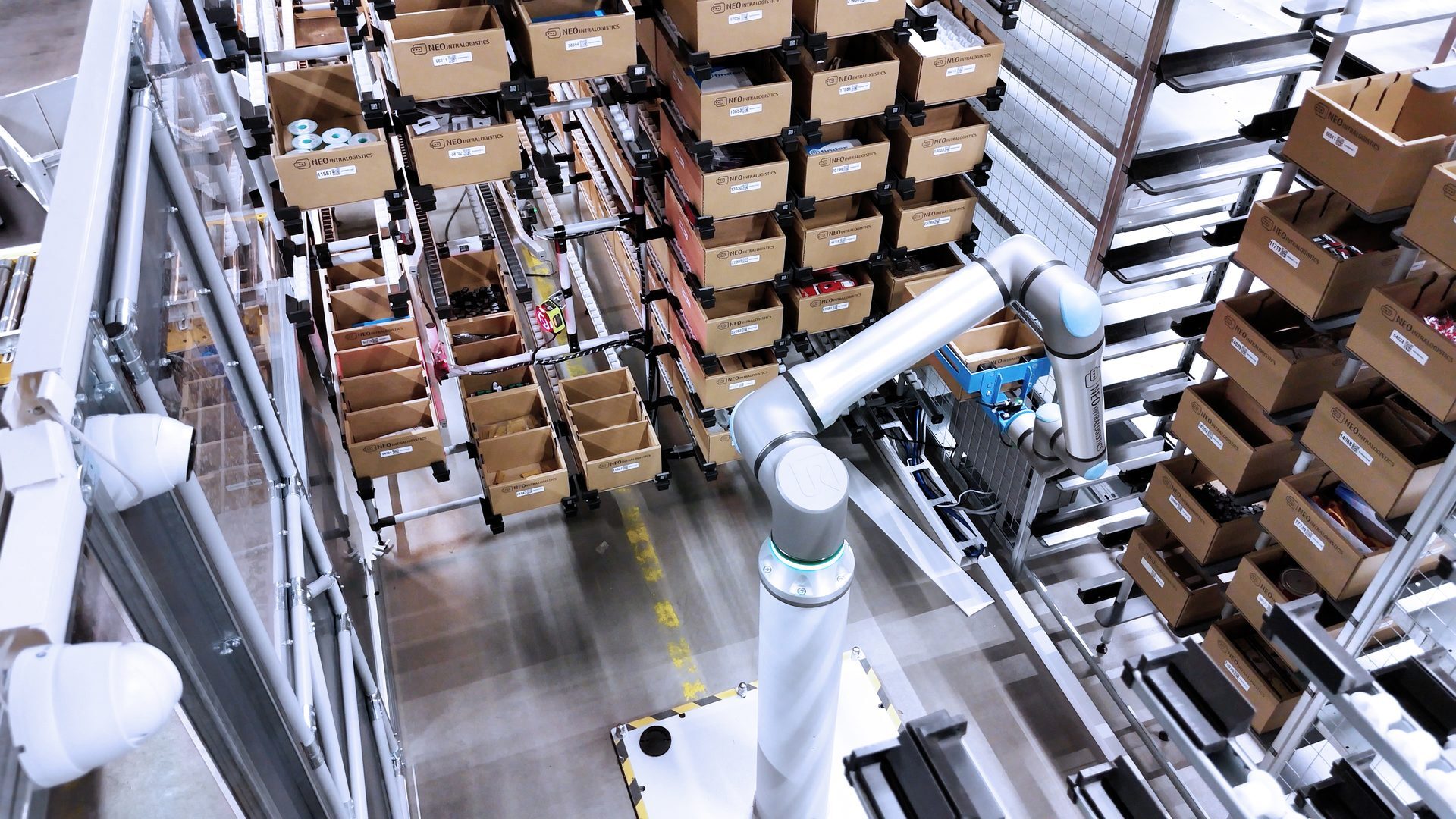
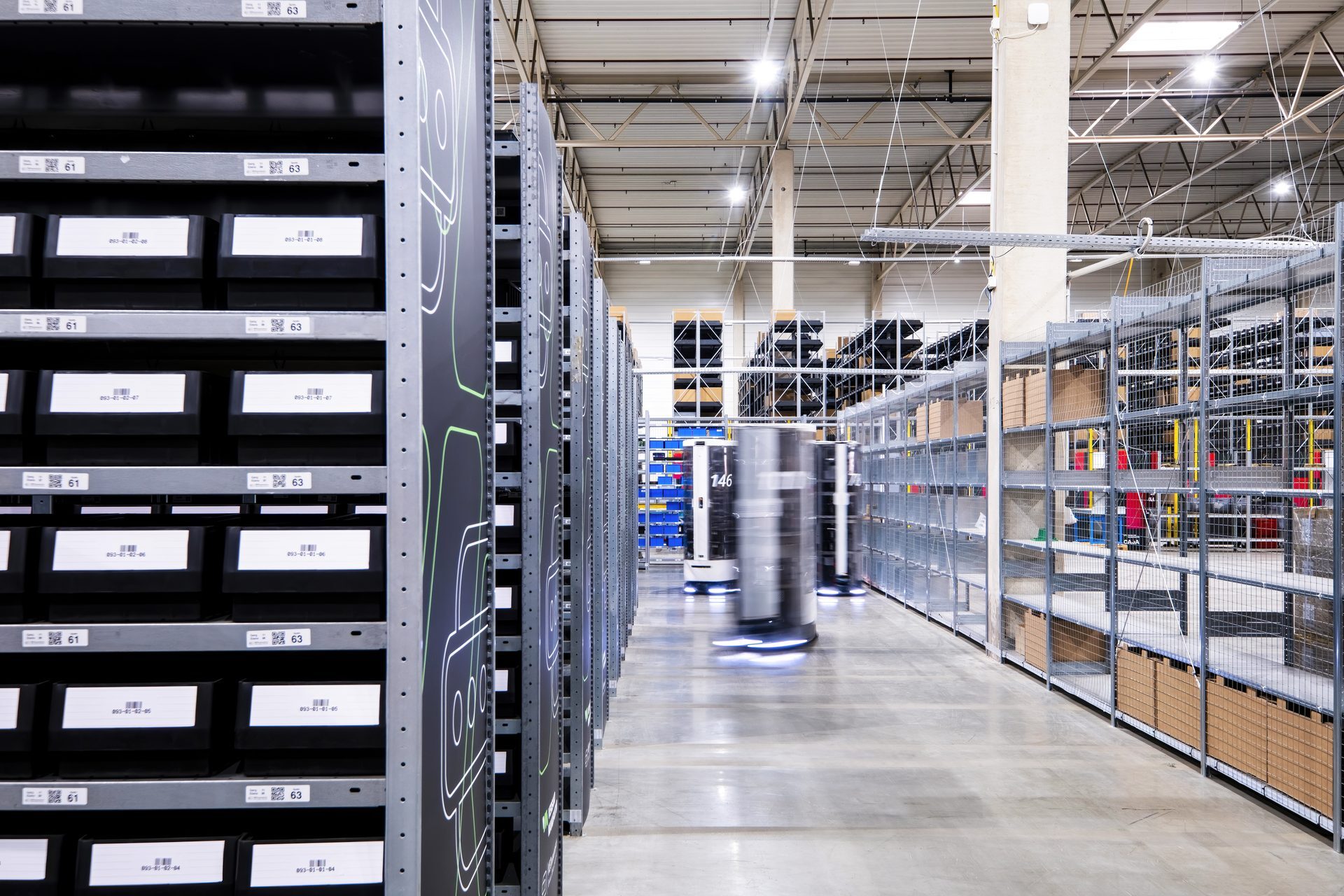
NEO's retrofit approach is one example of this shape, not the only one: goods-to-person automation that installs into existing shelf racking, goes live in six to eight weeks, and starts with a single station as an operating-cost decision. The point is not the vendor. It is that a small, fast, variable-cost entry defuses all six traps at once, because none of them requires a five-year, seven-figure commitment up front.
Seven questions to ask before signing
These questions surface the blind spots in most vendor conversations, whatever architecture you choose. Take the list into every meeting.
- How do you validate performance before we commit to the full rollout - simulation with our order history, a pilot phase, or both?
- Which performance figures do you guarantee contractually, and what happens if they are not met in live operation - penalties, rework, exit?
- What happens when a robot, shuttle, or crane fails - does the inventory stay accessible, or does an aisle go dark?
- What does scaling look like concretely if we need 50% more throughput in two to three years - what must be ordered, built, or reconfigured, at what cost, and with how much downtime?
- How does WMS integration actually run - phases, timeline, your responsibilities versus ours, and the rollback plan if the interface fails at go-live?
- Can we start with a pilot without committing to the full rollout, and what happens if the pilot misses expectations?
- What are the ongoing costs after go-live - maintenance, licenses, spares, updates - and what does the TCO look like over five and ten years?
Before you sign
If you are evaluating warehouse automation, the cheapest insurance is to get the comparison basis, the business model, and the site survey right before you talk to vendors. Our whitepaper walks through the architecture pre-selection in detail: warehouse automation market overview (in German).
For a second opinion on your specific site, one free session gives you a sober assessment of whether your building, volume, and business case fit a retrofit approach, with no obligation to a full rollout: See NEO in action.