Despite decades of technological progress, the vast majority of warehouses still rely on manual picking. The reason is not a lack of technology - it is that traditional automation solutions come with barriers that most operators cannot clear: multi-million CapEx, year-long implementation timelines, inflexible architectures, and poor compatibility with existing buildings.
Warehouse automation has been a strategic priority for logistics operators for years. Analyst reports consistently rank it among the top investment themes. Yet the numbers tell a different story: according to LogisticsIQ research, approximately 80% of warehouses worldwide operate with no or only minimal supporting automation.
The gap between intent and adoption is not about awareness. Operators know that automation can reduce labor dependency, increase throughput, and improve accuracy. The real problem is that traditional warehouse automation solutions - shuttle systems, automated storage and retrieval systems (AS/RS), and cube-based storage - were designed for greenfield environments and large-scale operations. They impose conditions that most warehouses simply cannot meet.
This article breaks down the five most common warehouse automation challenges and explains how a new generation of retrofit-first, OpEx-based solutions is eliminating them.
1. High capital expenditure shuts out most operators
The first and most visible barrier to warehouse automation is cost. Traditional systems demand significant upfront investment before a single pick is automated.
According to NEO's 2026 warehouse automation whitepaper, the orders of magnitude look like this:
- AS/RS (Automated Storage & Retrieval): multi-million, often in the tens of millions
- Shuttle systems: multi-million, often in the tens of millions
- Cube-based storage (e.g. AutoStore): a multi-million investment
For small and mid-sized operators running 5,000 to 50,000 square meters of warehouse space, these numbers represent a bet-the-company investment. Even larger enterprises face extended internal approval cycles and competing budget priorities.
The financial risk is compounded by long payback periods. Shuttle systems typically take 3-5 years to reach ROI; AS/RS installations can take 4-7 years. During that time, the business must absorb the full cost while hoping that demand forecasts hold.
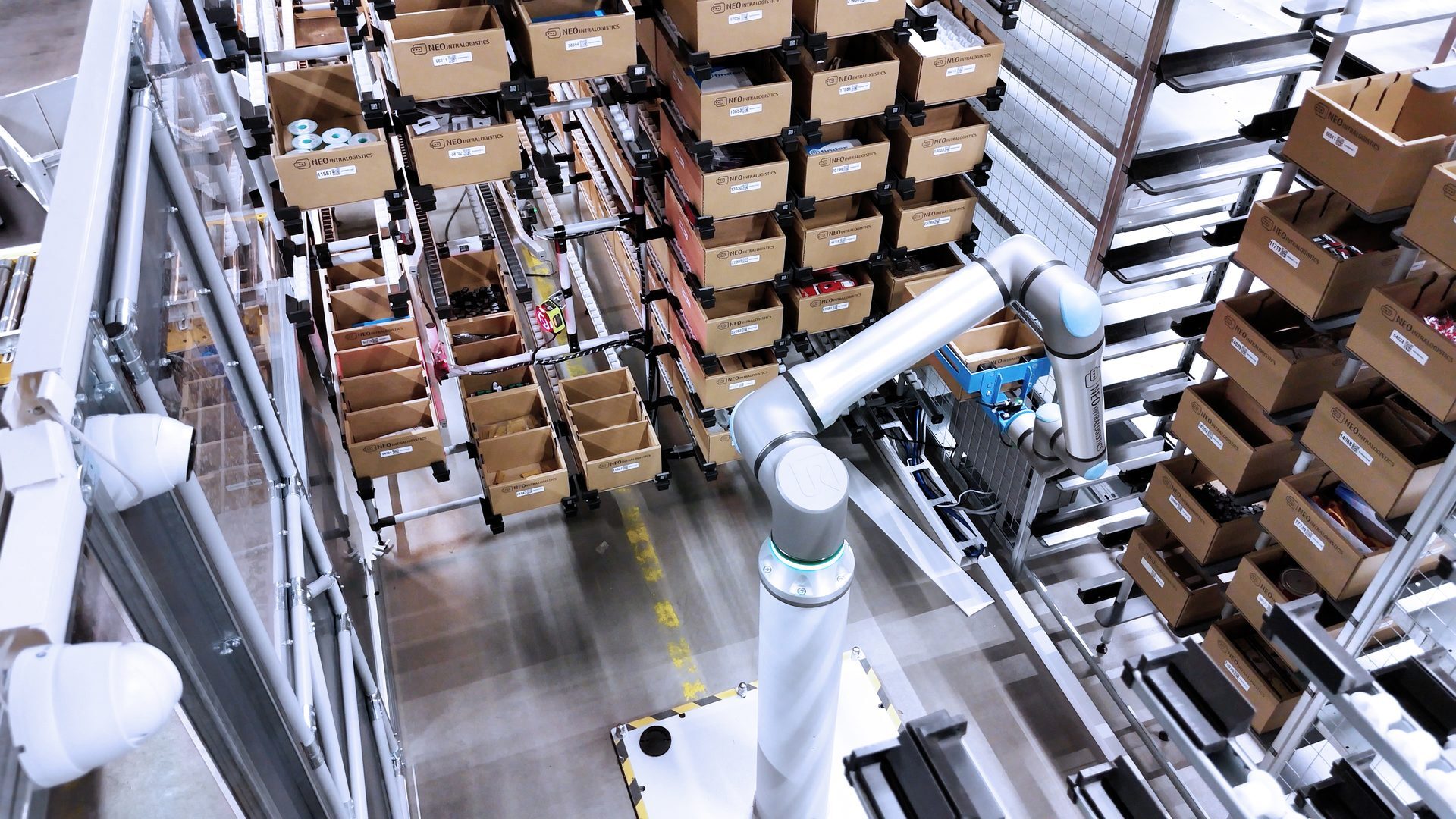
The alternative: AMR-based (Autonomous Mobile Robot) platforms like NEO's goods-to-person system operate on a pay-per-pick model with no upfront capital investment. Payback periods shrink to 1-2 years because the investment is operational, not capital.
2. Implementation timelines measured in years, not weeks
Even after securing budget approval, traditional warehouse automation projects move slowly. Planning, construction, system integration, and commissioning routinely stretch to 12-36 months for shuttle and AS/RS installations. Cube-based storage needs the same 12-36 months: the grid itself goes up faster, but the floor has to be cleared before it does.
During these extended timelines, operators face multiple risks:
- Operational disruption: Construction work inside an active warehouse creates safety concerns, noise, and restricted access zones.
- Opportunity cost: The labor savings and throughput improvements that justified the project remain unrealized for over a year.
- Scope creep: Requirements change during long projects. The system designed 12 months ago may no longer fit the business reality at go-live.
For operators dealing with acute labor shortages or rising labor costs, waiting 12-36 months for relief is not a viable option.
The alternative: AMR-based retrofit solutions can go live in 6-8 weeks. NEO deployments have moved from contract signature to first automated picks in under two months - with zero disruption to ongoing warehouse operations.
3. Rigid architectures that cannot adapt to change
Traditional automation systems are optimized for a specific warehouse layout, product mix, and throughput profile at the time of installation. Once built, they are difficult and expensive to change.
This rigidity creates problems in three common scenarios:
- Seasonal demand swings: An e-commerce fulfillment center that handles 3x volume during November and December needs scalable capacity - not a fixed installation sized for average demand.
- SKU portfolio changes: Retailers and distributors regularly add and remove product lines. Cube-based storage systems, in particular, impose strict constraints on item dimensions and weight.
- Business pivots: Mergers, new sales channels, or shifts from B2B to B2C fulfillment require warehouse operations to adapt quickly.
The cost of reconfiguring a shuttle system or expanding an AS/RS installation often rivals the original investment. Many operators end up running partially obsolete systems because the cost of change is prohibitive.
The alternative: AMR fleets scale linearly. Adding capacity means deploying more robots - a process that takes days, not months. Reducing capacity is equally straightforward: robots can be redeployed or returned. NEO customers have demonstrated this flexibility, scaling from a pilot zone to full warehouse coverage without construction or downtime.
4. Poor compatibility with existing (brownfield) warehouses
This is the challenge that stops the most projects before they start. The majority of logistics real estate in Europe consists of existing buildings with standard shelf racking (Fachbodenregal) - not purpose-built automation halls.
Traditional automation technologies have fundamental brownfield compatibility problems:
- AS/RS requires dedicated high-bay structures with reinforced floors, specific ceiling heights, and integrated conveyor systems. Retrofitting an existing warehouse for AS/RS typically means gutting the building.
- Shuttle systems need custom racking with integrated shuttle tracks, precise leveling, and dedicated charge stations. Existing shelving must be removed entirely.
- Cube-based storage (AutoStore and similar) requires tearing out all existing shelving and replacing it with a proprietary grid structure. The existing warehouse layout is essentially abandoned.
For operators who have invested in their current shelving infrastructure - and who need to keep operations running during any transition - these requirements are dealbreakers. The result is that brownfield warehouses remain manual while only new-build facilities get automated.
The alternative: AMR-based systems are the only automation architecture that works directly within existing Fachbodenregal without requiring construction, racking changes, or operational shutdown. NEO robots navigate standard aisle widths and integrate with the shelving already in place.
5. Integration complexity with existing WMS and ERP systems
The final challenge is often underestimated during the planning phase but becomes a major cost and timeline driver during implementation. Traditional automation systems require deep integration with the warehouse management system (WMS), enterprise resource planning (ERP) software, and often additional middleware layers.
These integrations are complex because:
- Legacy WMS platforms were not designed for real-time communication with automated systems
- Data formats, order structures, and inventory models differ between systems
- Custom integration work creates vendor lock-in and ongoing maintenance costs
Failed or delayed integrations are one of the top reasons warehouse automation projects exceed their budgets and timelines.
The alternative: NEO:os, the operating system powering NEO's AMR fleet, provides standardized API interfaces for common WMS and ERP platforms. The integration layer is part of the deployment scope and is validated during the pilot phase - before full-scale rollout.
Why these challenges persist - and why they are solvable now
The five challenges described above are not new. They have defined the warehouse automation landscape for over a decade. What has changed is the maturity of AMR technology and the emergence of OpEx-based business models that decouple automation from heavy capital investment.
The key differences between traditional and AMR-based automation:
| Factor | Traditional (AS/RS, Shuttle, Cube) | AMR-based (NEO) |
|---|---|---|
| CapEx | Multi-million (tens of millions) | Near-zero (pay-per-pick) |
| Implementation | 12-36 months | 6-8 weeks |
| Brownfield compatible | No (requires construction) | Yes (works in existing shelving) |
| Scalability | Fixed capacity | Linear scaling |
| Payback period | 2-7 years | 1-2 years |
For operators running existing shelf-racking warehouses - which is the majority of the European logistics market - the path to automation no longer requires clearing all five barriers simultaneously. A pilot-first approach lets operators validate results in a single aisle before committing to full-scale deployment.
Frequently Asked Questions
What is the biggest challenge in warehouse automation?
For most operators, the combination of high upfront investment (a multi-million CapEx for traditional systems) and poor compatibility with existing buildings is the primary blocker. AMR-based solutions address both by operating on a pay-per-pick model inside existing shelf racking.
Can you automate an existing warehouse without construction?
Yes. AMR (Autonomous Mobile Robot) systems are designed to work within existing Fachbodenregal (shelf racking) without requiring structural changes, new flooring, or racking replacement. NEO's system can be deployed as a retrofit in 6-8 weeks.
How long does warehouse automation take to implement?
Traditional systems (AS/RS, shuttle, cube storage) typically require 12-36 months. AMR-based systems like NEO can go live in 6-8 weeks, including WMS integration and staff training.
What is the ROI timeline for warehouse automation?
It depends on the technology. AS/RS installations typically take 4-7 years to reach payback. Shuttle systems take 3-5 years. AMR-based solutions with OpEx pricing models achieve payback in 1-2 years because there is no large upfront investment to amortize.
Is warehouse automation suitable for small and mid-sized warehouses?
Traditional automation is generally not economical below 10,000-15,000 square meters due to high fixed costs. AMR-based solutions scale down effectively because costs are variable (per pick) rather than fixed. NEO operates in warehouses starting from 2,000 square meters.
Ready to see it in action?
Skip the slide deck. See NEO in action and find out how NEO automates picking in existing shelf-racking warehouses - with no CapEx, no construction, and go-live in 6-8 weeks.