Request a Fit-Check

What Is Intralogistics?
Definition

Intralogistics refers to all internal logistics processes within a facility - the organization, control, and optimization of material and goods flow from receiving through storage, order picking, packing, and shipping. The term distinguishes internal warehouse operations from external logistics such as transportation, freight forwarding, and distribution. It also covers the information flows that steer these movements - typically managed by a warehouse management system (WMS).

Originally coined by the VDMA (German Mechanical Engineering Industry Association), “intralogistics” has become the standard term across the global supply chain industry for everything that happens inside the four walls of a warehouse or distribution center.

Core processes

Intralogistics encompasses a chain of interconnected processes:

  • Receiving: Accepting, identifying, and quality-checking incoming goods
  • Put-away: Transporting goods to storage locations and registering them in the Warehouse Management System (WMS)
  • Storage: Inventory management, stock optimization, and space utilization
  • Order picking: Assembling items from inventory to fulfill customer orders - the most labor-intensive process in any warehouse, accounting for 40-55% of total warehouse cost
  • Packing: Preparing orders for shipment according to requirements
  • Shipping: Staging and handing off to external carriers

Order picking dominates the cost structure because it is the most travel-intensive step. In a manual shelf-based warehouse, a picker walks 10-16 km per shift to collect items, and according to Tompkins et al. around 50% of picker time is spent walking rather than picking.

Supporting processes include internal transport, empty container management, and returns handling.

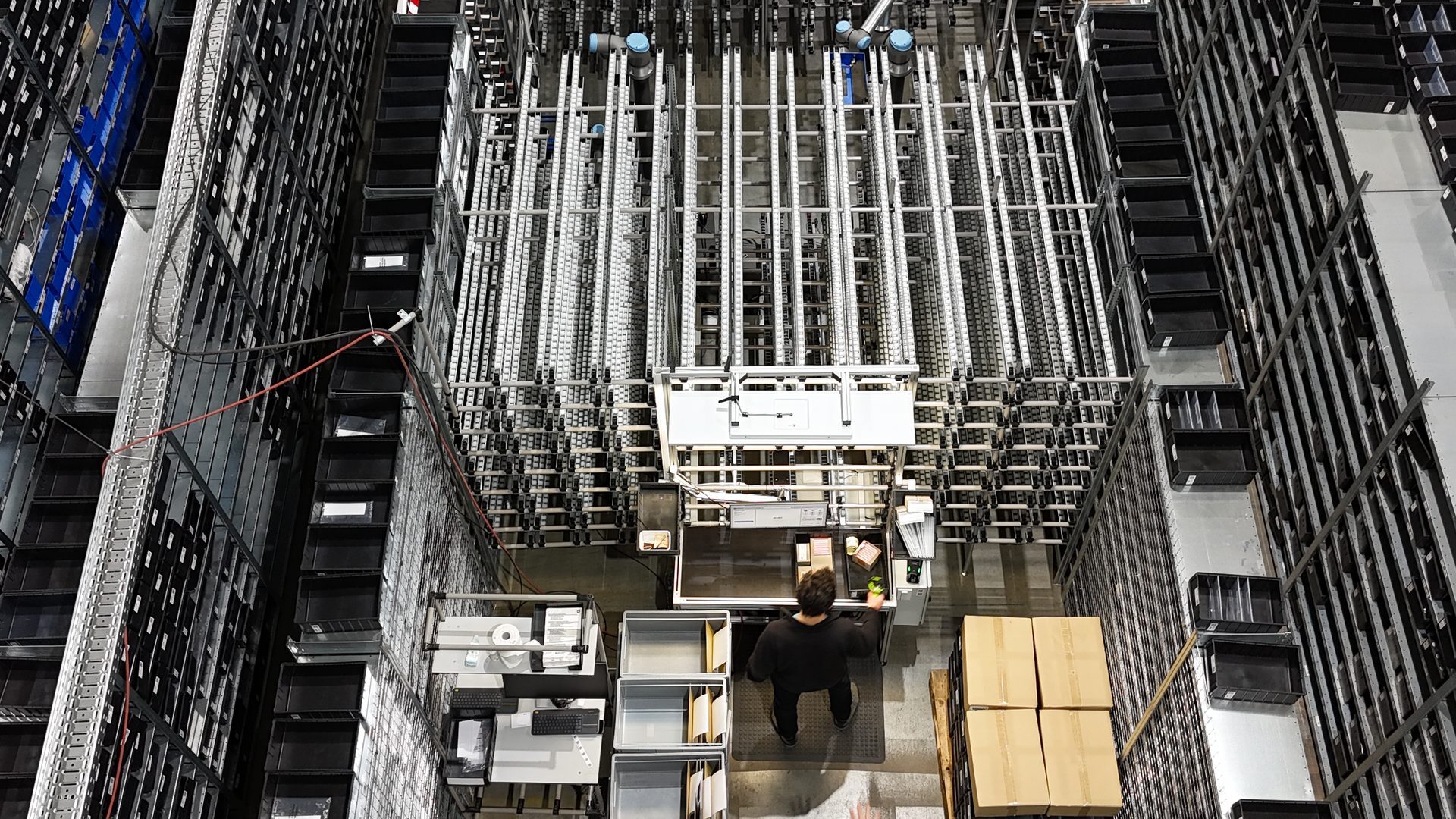
Pickstation from above showing operator at workstation and pushback compartments as bin buffer

Technologies and trends

The intralogistics industry is undergoing fundamental transformation:

  • Automation: From conveyor systems and stacker cranes to autonomous mobile robots (AMR) and goods-to-person systems. The goal is to reduce manual, repetitive tasks while increasing throughput.
  • Software orchestration: Modern Warehouse Management Systems (WMS), Warehouse Execution Systems (WES), and fleet management platforms coordinate people and machines in real time.
  • Industry 4.0 and IoT: Connected sensors, real-time analytics, and digital twins enable predictive maintenance and dynamic process optimization.
  • Retrofit over rebuild: Instead of replacing existing warehouses entirely, a growing number of companies are adopting automation solutions that integrate into existing infrastructure. This avoids the 12-36 month timelines typical of traditional automation projects and makes automation viable for mid-sized operations, not only large distribution centers.

NEO’s approach to intralogistics

NEOintralogistics is an intralogistics company focused on the retrofit case: automating order picking in existing shelf-based warehouses. An autonomous mobile robot (AMR) fleet retrieves bins from standard shelving, a goods-to-person station presents them to the picker, and the proprietary NEO:os operating system orchestrates both alongside the customer’s existing WMS - without modifications to the existing infrastructure. Deployments reach go-live in 6-8 weeks and cut picking labor by 70%, with no upfront investment under the pay-per-pick model.

Ready for the future of your warehouse?

See live how NEO automates your shelving warehouse - in our showroom in Bochum or via remote demo.

Request a Fit-Check