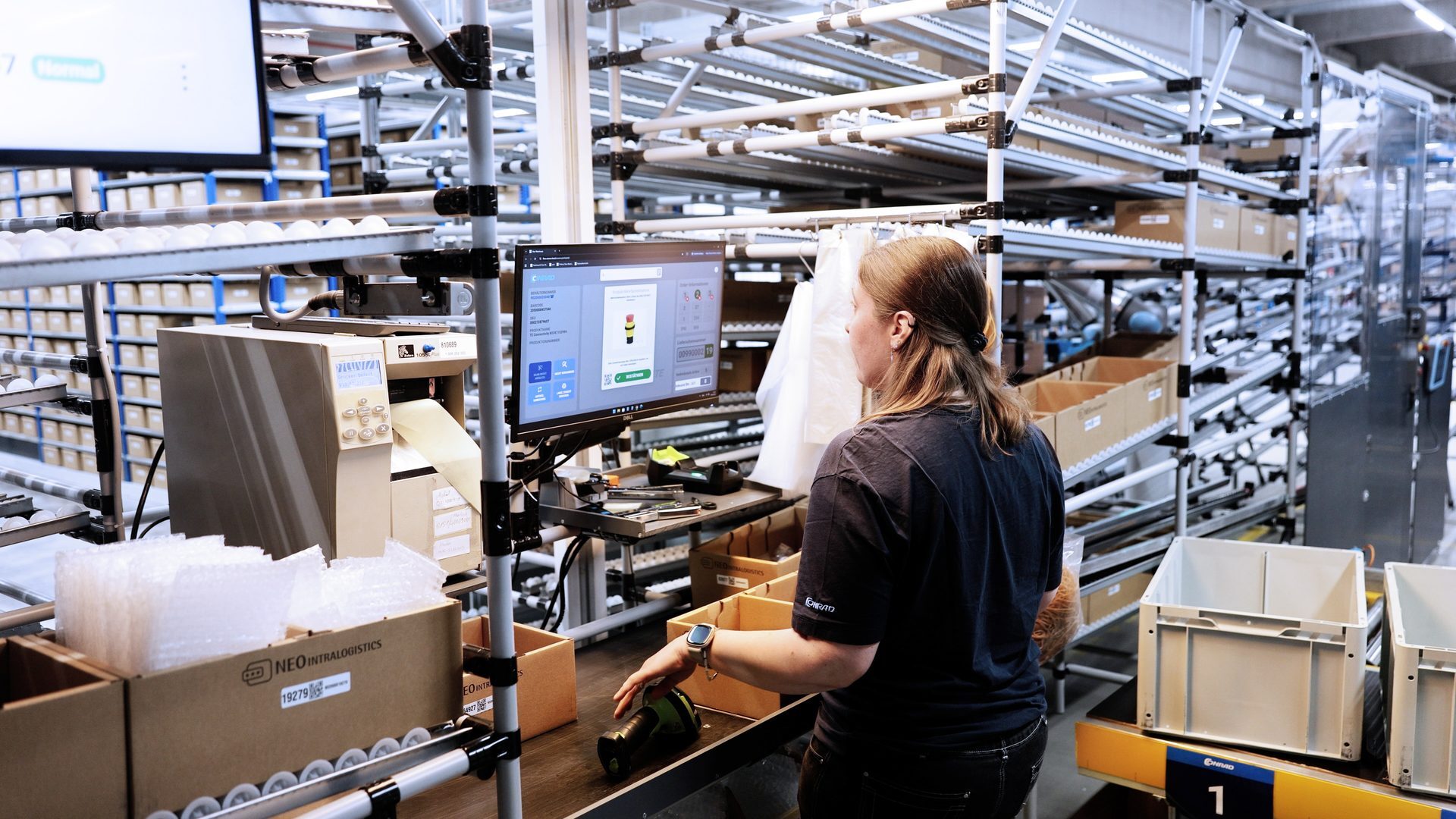
Warehouse Automation Without CapEx - You Only Pay for What You Pick
NEO automates your existing shelf-based warehouse on a pay-per-pick basis: you pay a fixed price per pick – no upfront investment, no lease, no fixed hardware costs. Robots, software, maintenance, and support are all included in the pick price. Your warehouse gets more productive. Your balance sheet stays clean.
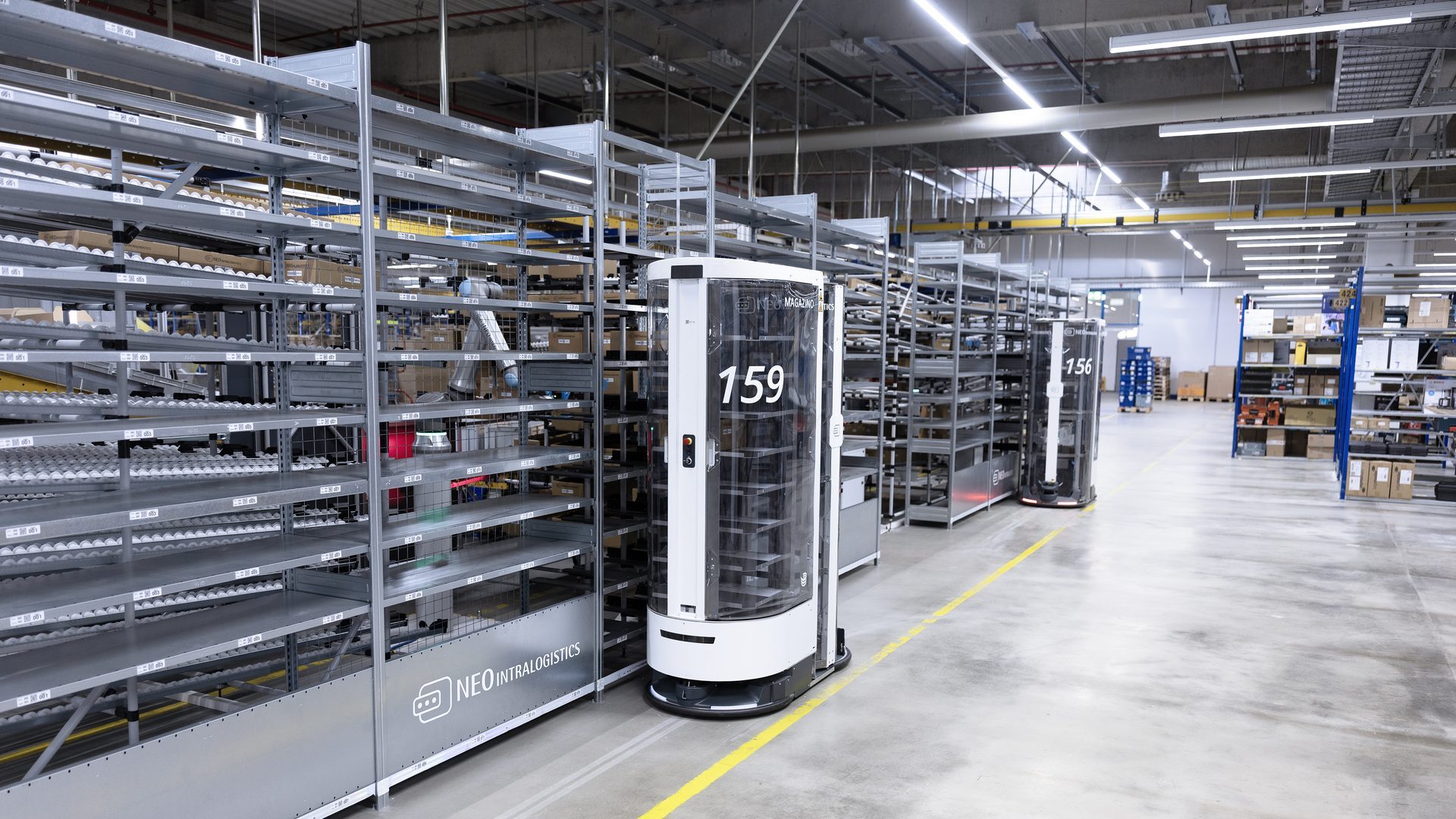
Pay-per-pick from NEOintralogistics converts warehouse automation from a capital expenditure into an operating cost. Companies pay per completed pick - including the NEO:runner fleet (autonomous mobile robots), picking station (goods-to-person workstation), NEO:os software, and full service. There is no upfront investment, no lease agreement, and no asset on the balance sheet. The solution goes live in 6-8 weeks.
What Is Pay-per-Pick?
Pay-per-pick is an operating-cost model for warehouse automation. Instead of buying or leasing robots, software, and infrastructure, you pay a fixed amount per completed pick.
Assessment
NEO evaluates your warehouse, SKU profile, and picking volume.
Installation
We integrate our NEO:runner fleet and picking station into your existing shelving - no reconstruction, no downtime. Go-live in 6-8 weeks.
Operation
You pick. We count. You pay only for what gets picked.
Scaling
Volume goes up? We scale the fleet. Volume goes down? Your costs go down with it.
The result: automation becomes a variable operating expense (OpEx) - no asset on the balance sheet, no depreciation schedule, no tied-up capital.
Pay-per-Pick: Impact in Numbers
What’s Included in the Price?
NEO:runner Fleet and NEO:pickstation
The NEO:runner fleet (autonomous mobile robots) and the picking station (goods-to-person workstation) with robot arm are included in the pick price - including installation and commissioning.
NEO:os Software
Orchestration, WMS integration, dashboard, and all software updates are included. No separate license agreement needed.
Maintenance, Support, and Scaling
Hardware maintenance, repair, remote and on-site support, and additional robots as volume grows - all included in the pick price.
What’s not included: Your existing shelving system, warehouse floor space, network infrastructure, and WMS licenses remain your responsibility. NEO integrates into your existing infrastructure - we don’t replace it.
| Component | Included |
|---|---|
| NEO:runner fleet (AMR) | Yes |
| NEO:pickstation (goods-to-person workstation) | Yes |
| NEO:os software platform (orchestration, WMS integration, dashboard) | Yes |
| Installation and commissioning | Yes |
| Maintenance and repair - hardware and software | Yes |
| Software updates and new features | Yes |
| Support - remote and on-site | Yes |
| Scaling - additional robots as volume grows | Yes |
What’s not included: Your existing shelving system, warehouse floor space, network infrastructure, and WMS licenses remain your responsibility. NEO integrates into your existing infrastructure - we don’t replace it.
Pay-per-Pick Makes Collaborative Picking Economically Viable
Pay-per-pick isn’t just a convenient cost model - it’s the economic precondition that makes collaborative picking (robots and human pickers in the same picking cycle) actually work in practice.
The dilemma of conventional warehouse automation: the system is built once, locking capacity in for years. Size it for peak demand and you depreciate idle capacity eleven months a year. Size it for average and you break during peak season.
With NEO and pay-per-pick, the math works differently:
- You size the robot fleet for average load - and you only pay for picks the robots actually perform.
- During peak season, you add human pickers alongside the robots - more picks per day, pay-per-pick scales proportionally with volume.
- Off-peak, volume drops, costs drop - no depreciation on hardware that sits idle.
A CapEx model would penalize this flexibility: you’d have bought hardware that’s either too much or too little for ten months out of twelve. Pay-per-pick ties cost directly to performance - the key that makes humans + robots in the same warehouse economically possible without you carrying the volume risk.
Pay-per-Pick vs. CapEx vs. Leasing: Comparison
| Pay-per-Pick (NEO) | CapEx (traditional AS/RS, mini-load) | |
|---|---|---|
| Upfront investment | €0 | €500k-5M+ (Leasing: €0 + deposit) |
| Balance sheet impact | OpEx - no capitalization | Fixed asset + depreciation (Leasing: depends on lease type, on/off-balance) |
| Cost when volume drops | Decreases proportionally | Stays fixed (Leasing: fixed payment) |
| Cost when volume grows | Increases proportionally | Capacity ceiling → new investment (Leasing: new contract) |
| Peak capacity (collaborative picking) | Robots + human pickers in the same picking cycle - add people seasonally without buying hardware | Built-in fixed capacity - seasonal expansion requires additional hardware or downtime (Leasing: same constraint, plus contract term) |
| Implementation time | 6-8 weeks | 12-36 months (Leasing: 12-36 months + procurement) |
| Maintenance and support | Included | Separate service contract (Leasing: also separate) |
| Technology risk | With NEO - you always use current tech | With you - depreciation over 10+ years (Leasing: shared risk) |
| Flexibility | High - scalable, terminable | Low - tied to infrastructure (Leasing: medium - tied to contract term) |
| Best suited for | Variable volumes, 3PL, mid-market | Stable high-volume sites (Leasing: companies with credit lines) |
ROI Calculator
Calculate your savings potential. Our ROI calculator shows you how pay-per-pick impacts your picking costs - based on your actual volume and labor costs.
Enter your metrics:
- Picks per day
- Number of pickers
- Average labor cost per hour
- Shift model
You'll receive a side-by-side comparison of your current costs versus the pay-per-pick model - including projected annual savings.
Request a custom quote → - or let us walk through the calculation together.
Who Benefits from Pay-per-Pick?
Pay-per-pick is ideal for:
- 3PL operators with fluctuating client volumes - costs adjust automatically. Learn more about the 3PL use case
- Mid-market companies that cannot justify a seven-figure investment in warehouse automation
- Companies with seasonal fluctuations - you pay less in the off-season
- CFOs and procurement teams that prefer OpEx over CapEx and want to minimize tied-up capital
- Sites with existing shelf-based racking - no infrastructure investment needed. How the retrofit works
Not the best fit for:
- Ultra-high-volume sites with >100,000 picks/day where a fully automated AS/RS is more economical
- Companies that require ownership of hardware assets (e.g., for regulatory reasons)
- Warehouses handling exclusively pallets (NEO automates shelf-based storage, not pallet warehouses)
References
Versandmanufaktur / GLS: Automated picking in an existing shelf-based warehouse - live in under 8 weeks. → Read the case study
Conrad Electronic: Existing warehouse automated with zero reconstruction and zero downtime. → Read the case study
FAQ
What is a pay-per-pick model?
A pay-per-pick model means you do not pay a purchase price or a lease payment for warehouse automation. Instead, you pay a fixed amount for every pick the robots perform in your warehouse. All costs for hardware, software, maintenance, and support are included in this per-pick price.
How does pay-per-pick differ from leasing?
With leasing, you pay a fixed monthly rate - regardless of how much you pick. Pay-per-pick is volume-dependent: fewer picks = lower costs. Additionally, pay-per-pick includes maintenance, support, and software updates, while leasing typically only covers hardware financing.
What does a single pick cost?
The per-pick price depends on your volume, SKU profile, and warehouse layout. There is no list price - we calculate individually based on your actual requirements. Request a custom quote.
Is there a minimum contract term?
Yes. The specific term is determined during the quoting phase and depends on the project scope. Within the contract term, you benefit from a fixed per-pick price.
What’s included in the pay-per-pick price?
Everything you need for automated picking: the NEO:runner fleet (autonomous mobile robots), the picking station (goods-to-person workstation), the NEO:os software platform, installation, maintenance, repair, software updates, and support. Your existing shelving system and WMS remain your responsibility.
Request a Quote
Find out in a 30-minute call how pay-per-pick works in your warehouse - with a concrete cost estimate based on your data. Or start with an overview of the NEO platform.
Request a Fit-Check