Request a Fit-Check

The NEO Solution - Warehouse Automation That Retrofits

NEO is an integrated automation solution for existing shelf-based warehouses. It combines the NEO:runner fleet (autonomous mobile robots), a picking station - the goods-to-person workstation with a robot arm - and NEO:os orchestration software into a single system that retrofits into existing racking with no construction. Operated as pay-per-pick with no upfront investment.

NEO is an integrated automation solution for existing shelf-based warehouses. It combines the NEO:runner fleet (autonomous mobile robots), a picking station - the goods-to-person workstation with a robot arm - and NEO:os orchestration software into a single system that retrofits into existing racking with no construction. Operated as pay-per-pick with no upfront investment.

Best fit for

  • Existing shelf-based warehouses with manual order picking
  • 3PL and multi-client fulfillment environments with changing requirements
  • E-commerce and omnichannel operations facing labor shortages and seasonal peaks
  • Operators who prefer a pilot-first rollout with an OpEx pricing model

Not ideal for

  • Optimized greenfield projects that justify rigid shuttle or AS/RS systems
  • Warehouses outside NEO’s item, aisle, or throughput constraints
  • Buyers seeking a one-time hardware purchase rather than performance-based automation

Three Components, One System

The NEO solution consists of three core components that work as an integrated system - not standalone solutions bolted together after the fact.

NEO:os - Warehouse Automation Software

NEO:os is the central orchestration software of the solution. It handles order management, NEO:runner fleet coordination, shelf-level inventory tracking, and real-time synchronization between the robot fleet and the picking station. NEO:os connects to your existing WMS via REST API.

NEO:pickstation - Goods-to-Person Workstation

The picking station - the goods-to-person workstation - is where picking happens. A robot arm receives the bin from the NEO:runner and presents it to the picker in an ergonomic position. The operator removes the item, handles exceptions, and confirms complex picks. Walking is eliminated entirely.

NEO:runner Fleet - Autonomous Mobile Robots in the Aisle

NEO:runner robots navigate autonomously through existing warehouse aisles. They identify the target bin on the shelf using 3D cameras, retrieve it, and transport it to the picking station. The robots operate in your existing racking - no modifications, no floor markings, no dedicated lanes.

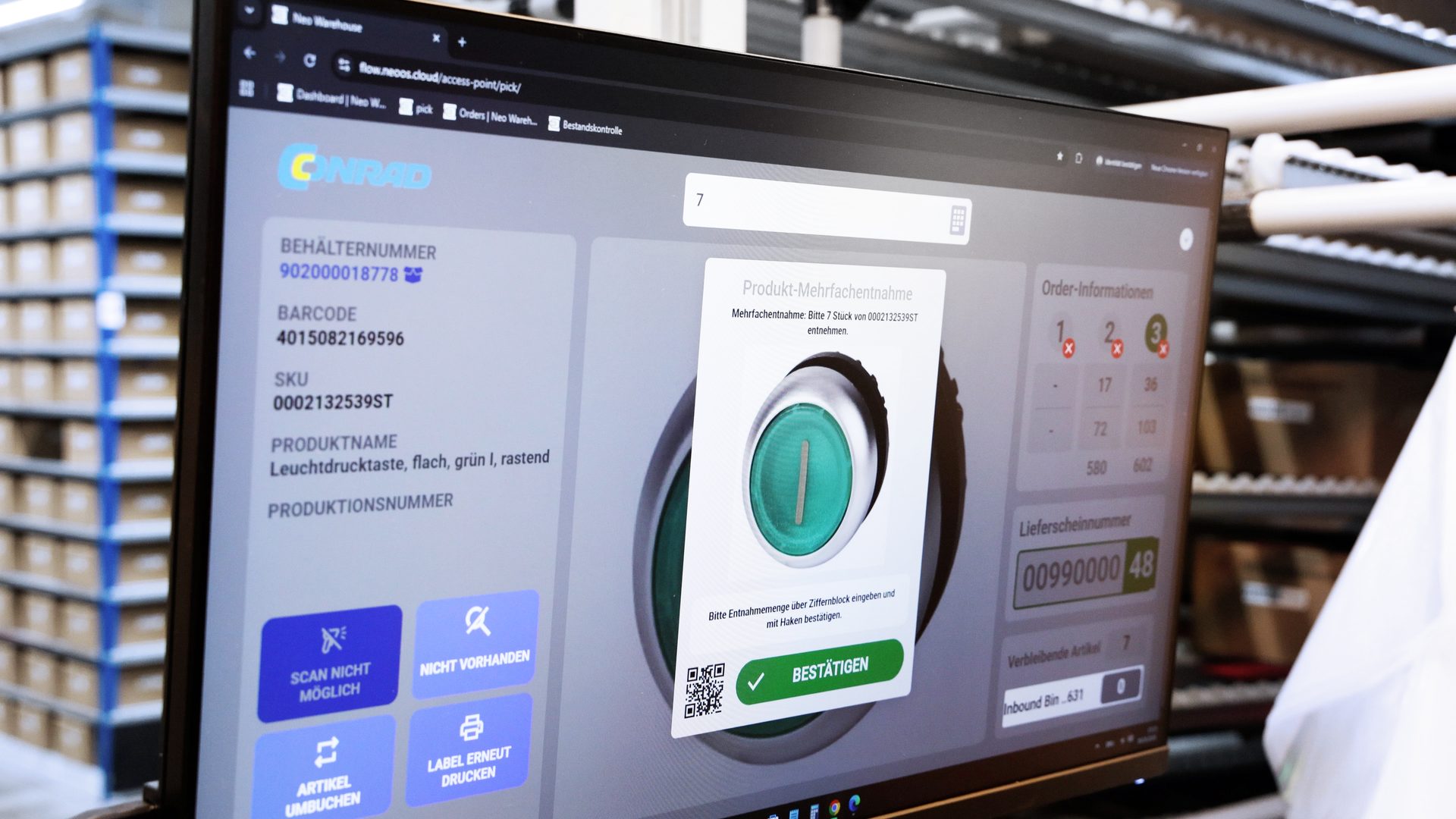
NEO:os software dashboard - order management and fleet coordination

NEO:os - Warehouse Automation Software

NEO:os is the central orchestration software of the solution. It handles order management, NEO:runner fleet coordination, shelf-level inventory tracking, and real-time synchronization between the robot fleet and the picking station.

NEO:os connects to your existing WMS via REST API. It does not replace your WMS - it adds the automation layer. Orders flow from your WMS into NEO:os, are translated into optimized robot missions, and completed picks are reported back.
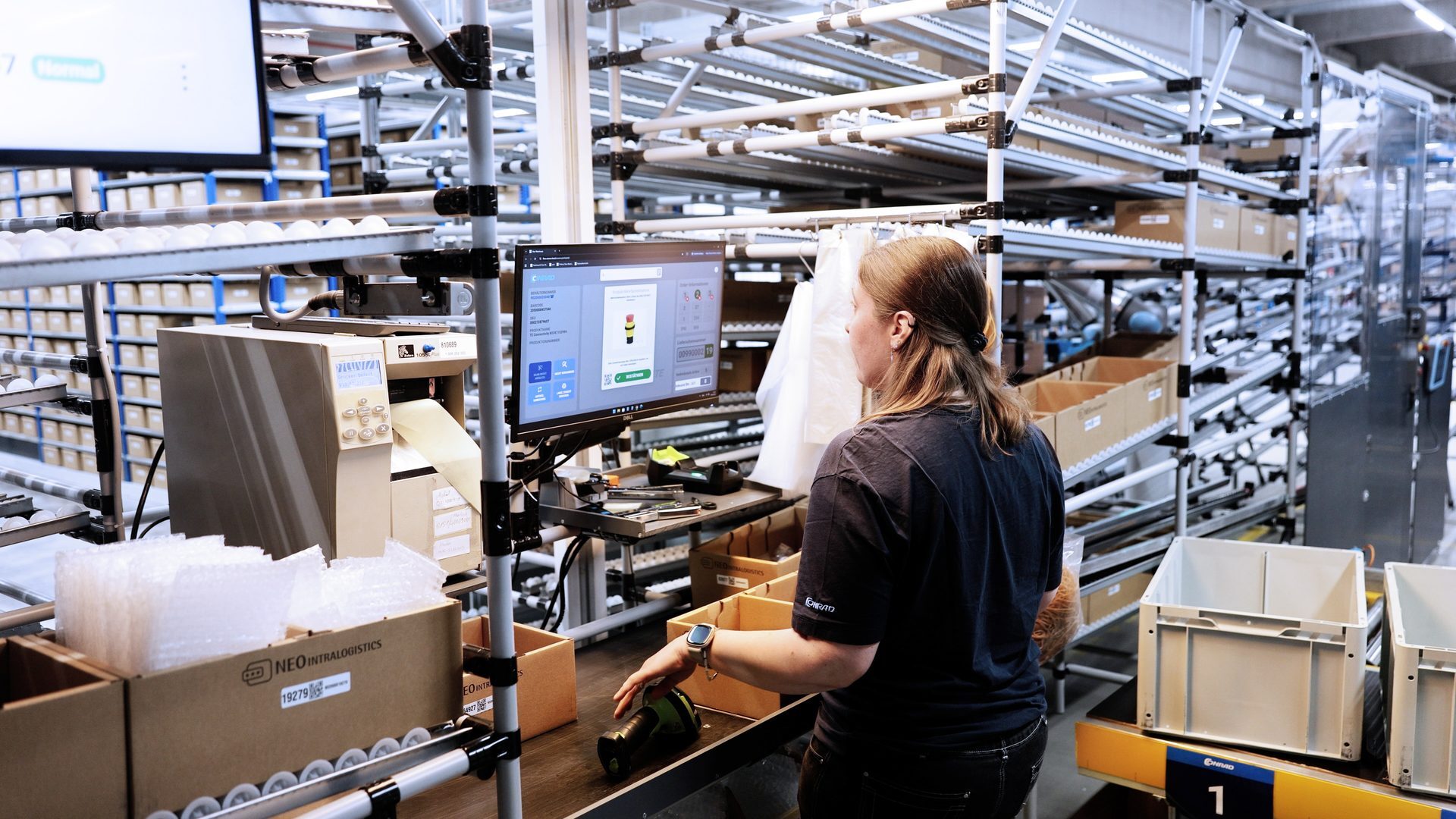
NEO:pickstation - operator at ergonomic picking workstation

NEO:pickstation - Goods-to-Person Workstation

The picking station - the goods-to-person workstation - is where picking happens. A robot arm receives the bin from the NEO:runner and presents it to the picker in an ergonomic position. When needed, it buffers the bin in a pushback compartment until the pick is due.

The operator at the picking station removes the item, handles exceptions, and confirms complex picks. The station is ergonomically designed and eliminates walking entirely - goods come to the person, not the other way around.
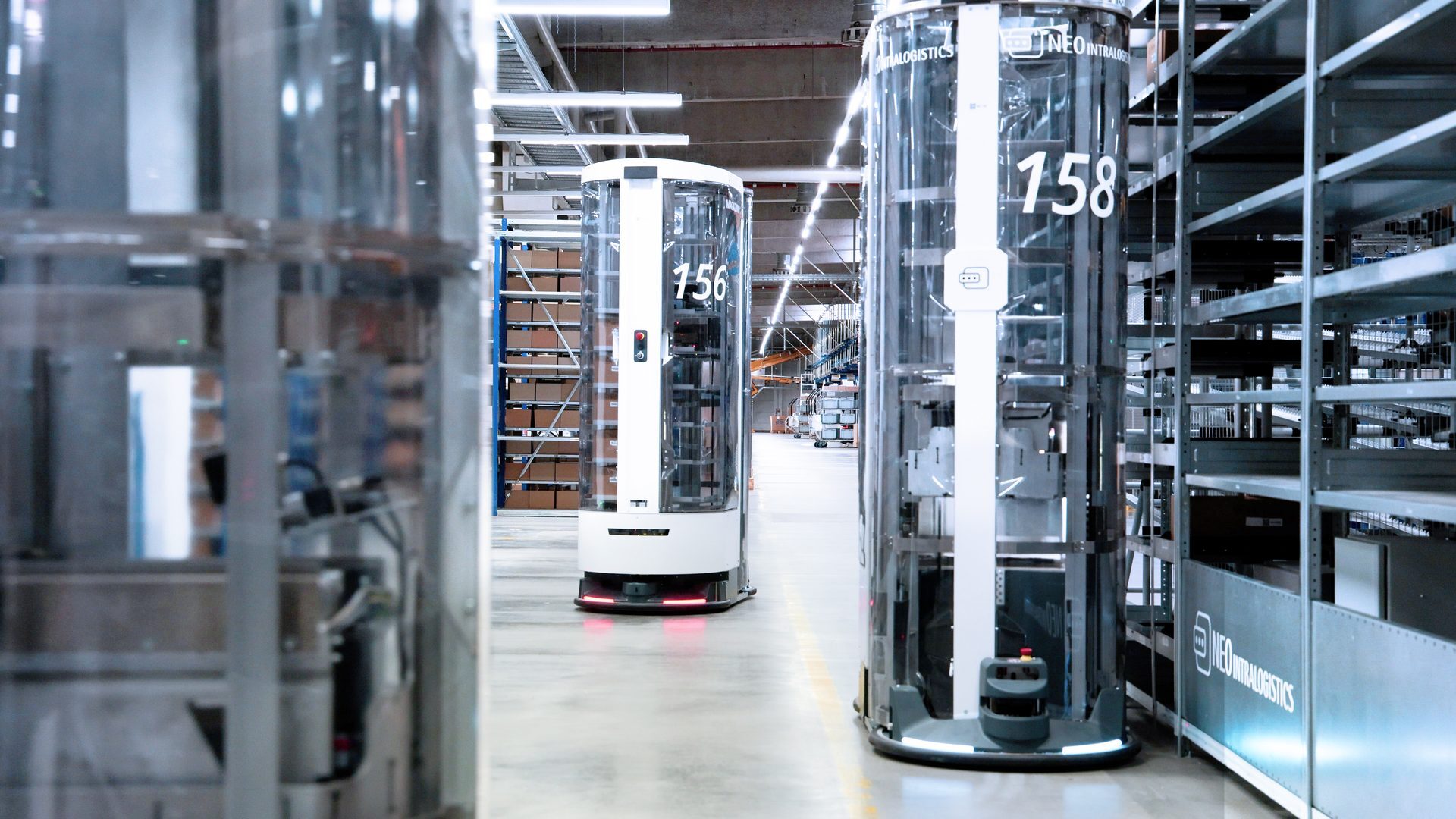
Two NEO:runner robots side by side in warehouse aisle

NEO:runner Fleet - Autonomous Mobile Robots in the Aisle

NEO:runner robots navigate autonomously through existing warehouse aisles. They identify the target bin on the shelf using 3D cameras, retrieve it, and transport it to the picking station.

The robots operate in your existing racking - no modifications, no floor markings, no dedicated lanes. They share space with manual pickers, enabling parallel operation during the pilot phase.

Operator at picking workstation - collaborative picking with AMR fleet in the same warehouse

Collaborative Picking - Robots and People in the Same Picking Cycle

NEO is one of very few automation solutions where robots and human pickers operate in the same physical space and the same picking cycle - collaborative picking, not two separate worlds.

This breaks the central trade-off of conventional warehouse automation:

  • Size the system for peak demand, and you pay for idle capacity eleven months a year that you only need during peak season.
  • Size it for average demand, and you break during peak season - turning away volume or staffing up expensive temporary labor.

With NEO, you size the robot fleet for average load - and add human pickers alongside the robots when seasonal demand spikes. One process, one warehouse, no parallel manual operation to maintain, train, and staff separately.

The pay-per-pick model carries this commercially: you only pay for picks actually performed - more during peak, less off-season. No fixed depreciation on capacity you only use occasionally.

How NEO Works in Your Warehouse

1

Order intake

Your WMS sends pick orders via API to NEO:os. The software groups orders, optimizes travel paths, and assigns missions to available robots.

2

Bin transport

A NEO:runner drives to the shelf location, identifies the target bin via 3D vision, and retrieves it. The robot transports the bin to the picking station.

3

Station handling

At the picking station, the robot arm takes over the bin and either presents it directly to the picker or buffers it in the pushback compartment. The pick happens at the workstation, and multi-order picking allows several orders to be processed in parallel.

4

Confirmation

NEO:os reports the completed pick back to your WMS. Inventory, order status, and performance metrics are visible in real time.

The entire process runs without any changes to your warehouse layout. Existing shelving stays in place.

More on retrofit integration

Technical Specifications & Fit-Check

Warehouse type Existing shelf-based warehouse
Aisle width Min. 85 cm
Usable shelf height Up to 250 cm
Max item dimensions 380 x 270 x 140 mm L × W × H
Max item weight 5 kg
Daily volume 5,000+ picks/day recommended
Deployment model Pilot → staged rollout
Commercial model Pay-per-pick - no CapEx → /en/platform/pay-per-pick/

The physical constraints (aisle width, shelf height, item size) determine whether NEO can operate in your warehouse. The daily volume determines whether the investment case works. If your warehouse meets the physical criteria and you process more than 5,000 picks per day, NEO is a realistic option.

Proven Results

70%
less picking labor
2-3×
storage capacity
6-8weeks
to go-live
99.9%
picking accuracy

Expert Voices

Ralf Bühler
Currently, there is no other provider besides NEO that offers goods-to-person automation specifically for shelf-racking environments.

Ralf Bühler
CEO, Conrad Electronic SE
Dr. Knut Alicke
NEO's solution is a game-changer in warehouse automation.
Dr. Knut Alicke
former McKinsey Partner, supply chain expert
NEO:os WMS integration browser view

WMS Integration and IT Architecture

NEO:os integrates with your existing WMS via a standardized REST API. The integration follows a clear principle: your WMS remains the leading system for inventory and orders. NEO:os handles only the automation layer.

Data flow:

  1. WMS sends pick orders to NEO:os (REST API)
  2. NEO:os optimizes, plans, and executes robot missions
  3. NEO:os reports picks, inventory movements, and status updates back to WMS
  4. Dashboard shows real-time KPIs: picks/hour, robot utilization, throughput

IT requirements:

  • Wi-Fi coverage in the warehouse area (for AMR communication)
  • REST API capability in your WMS (or middleware integration)
  • No dedicated on-site server required - NEO:os runs cloud-based

Integration is not a major project. In previous installations, customer-side IT effort was a matter of a few person-days. The NEO team handles configuration, mapping, and testing.
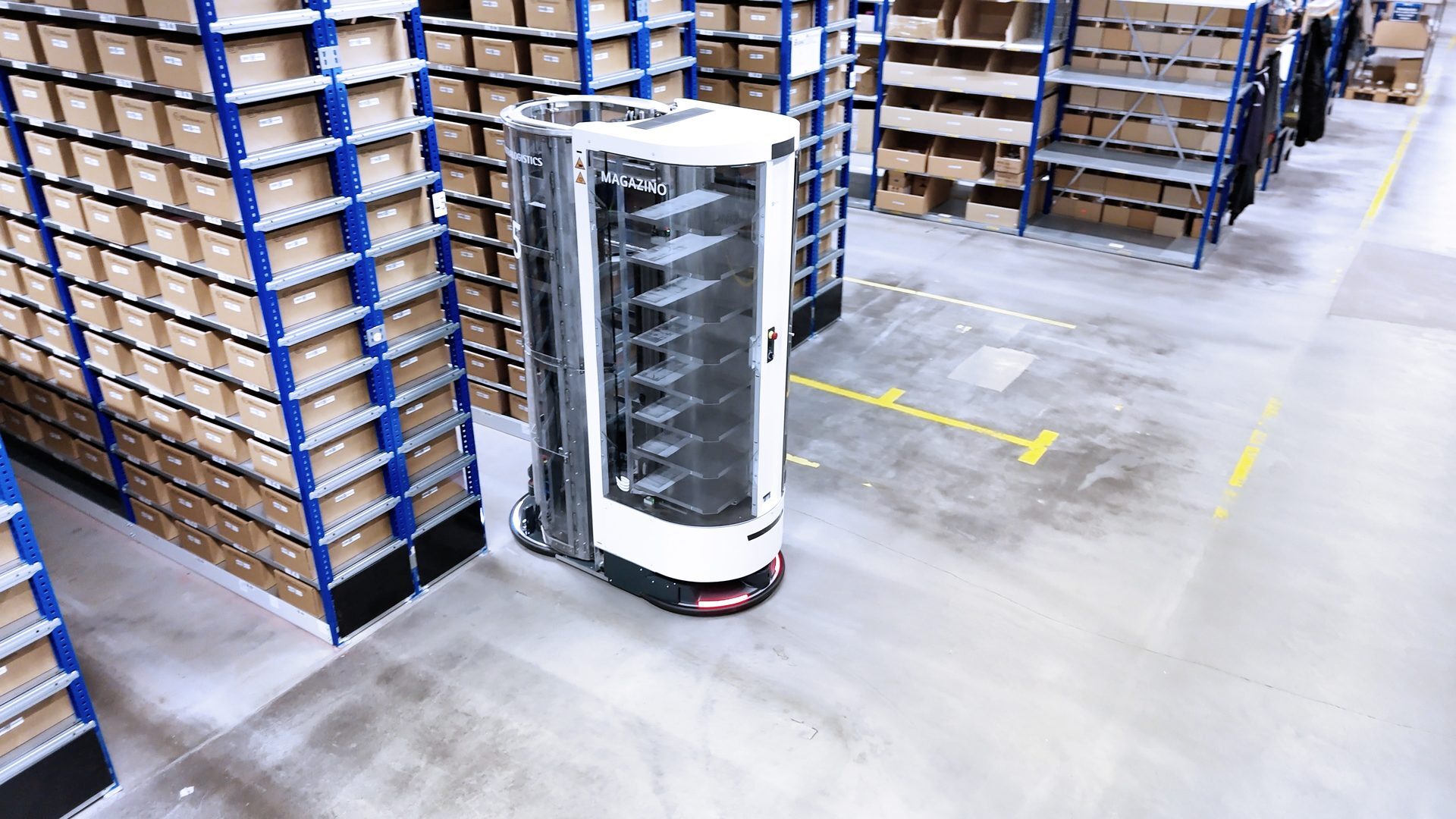
NEO:runner in open warehouse aisle - parallel operation with manual picking

Operational Reliability, Service, and Rollout Model

Rollout model: pilot first. Every NEO installation starts with a pilot - typically one to two robots and one station in a defined warehouse area. The pilot runs in parallel with manual operations without disrupting them. Scaling follows only after validated operation.

  • Go-live: 6-8 weeks from contract signature
  • Scaling: Additional robots and stations added during live operations
  • Parallel operation: Robots and manual pickers work in the same warehouse

Commercial model: Pay-per-pick - no investment costs, no lease. You pay per pick, including robots, software, maintenance, and service. The volume risk sits with NEO, not with you.

NEO is not conventional automation that requires rigid cube systems or construction. It is a retrofit system that fits into your existing warehouse.

Frequently Asked Questions

What warehouse dimensions does NEO require?

NEO:runner robots require a minimum aisle width of 85 cm and operate at shelf heights up to 250 cm. Existing shelving remains unchanged - no structural modifications are needed.

What item sizes can NEO handle?

Maximum item dimensions are 380 x 270 x 140 mm with a maximum weight of 5 kg per item. This covers typical e-commerce and spare parts assortments.

What is the minimum daily volume for NEO?

A minimum of 5,000 picks per day is recommended for the economics to work. For lower volumes, a pilot operation can help validate suitability.

What picking accuracy does NEO deliver?

NEO achieves picking accuracy above 99.9% through camera-guided item recognition and software-based verification. Every pick is documented in NEO:os and fully traceable.

Request a Fit-Check

See NEO in action - with your item data, your warehouse layout, and your volumes. We’ll show how NEO:os integrates with your WMS, how the NEO:runner robots operate in your racking aisles, what results are realistic for your item range, and how the pilot launch works within 6-8 weeks.

Request a Fit-Check