Request a Fit-Check

NEO vs. Cube-Based AS/RS

Cube-based AS/RS systems like AutoStore, Jungheinrich PowerCube, or GridStore use cube-based AS/RS in purpose-built facilities. NEO automates your existing shelving - no construction, no capital investment. Both approaches have merit. The right choice depends on where you are today and where you need to go.

Cube-based AS/RS systems (e.g., AutoStore) deliver extreme storage density for small items in greenfield projects but require significant investments – often in the tens of millions – and 12-36 months of lead time before go-live. NEO from NEOintralogistics automates existing shelf-based warehouses with zero CapEx on a pay-per-pick model, goes live in 6-8 weeks, and scales from a single station.

Comparison Table

NEO Cube-Based AS/RS (e.g., AutoStore)
Rack compatibility Uses existing shelf-based racking - no new storage system required Proprietary cube-based AS/RS and bin system - existing racking is not reused
CapEx vs. OpEx Zero CapEx - pay-per-pick as a pure OpEx model High CapEx (often in the tens of millions), typical payback 2-4 years
Time-to-value 6-8 weeks from contract to go-live 12-36 months until go-live (planning, construction, installation, commissioning)
Building modification None - operates in existing aisles (from 85 cm width) Significant - new building or major retrofit for cube-based structure and higher floor load capacity (load per m²)
Pilot scalability From 1 station and 2-3 robots - incremental expansion at any time Pilots are not possible due to the cube-based infrastructure - the grid has to be built at full size before the first pick
Peak flexibility (collaborative picking) Robots and human pickers operate in the same workflow. Size the fleet for average load, then add people alongside the robots when seasonal demand spikes - no idle capacity off-peak Capacity is fixed upfront by cube size, ports, and layout. Size for average and peaks break; size for peak and pay for idle infrastructure eleven months a year
Software orchestration role NEO:os controls NEO:runner fleet, picking station (goods-to-person workstation), and WMS integration. → Solution overview Proprietary control software from the manufacturer - deep integration but vendor lock-in

NEO is the better choice when:

  • Existing warehouse with shelf-based racking - no rebuild possible or desired
  • No CapEx budget - automation as operating expense (OpEx) preferred
  • Fast results in 6-8 weeks instead of 18 months
  • Start small and scale on success - one station, one aisle, one PoC

A cube-based AS/RS is the better choice when:

  • New build or greenfield site with the facility designed around the storage system
  • Extremely high storage density for small to medium items in standard bins (cube bins are too large for the smallest components)
  • Stable volume over 10-15 years to amortize the multi-million investment
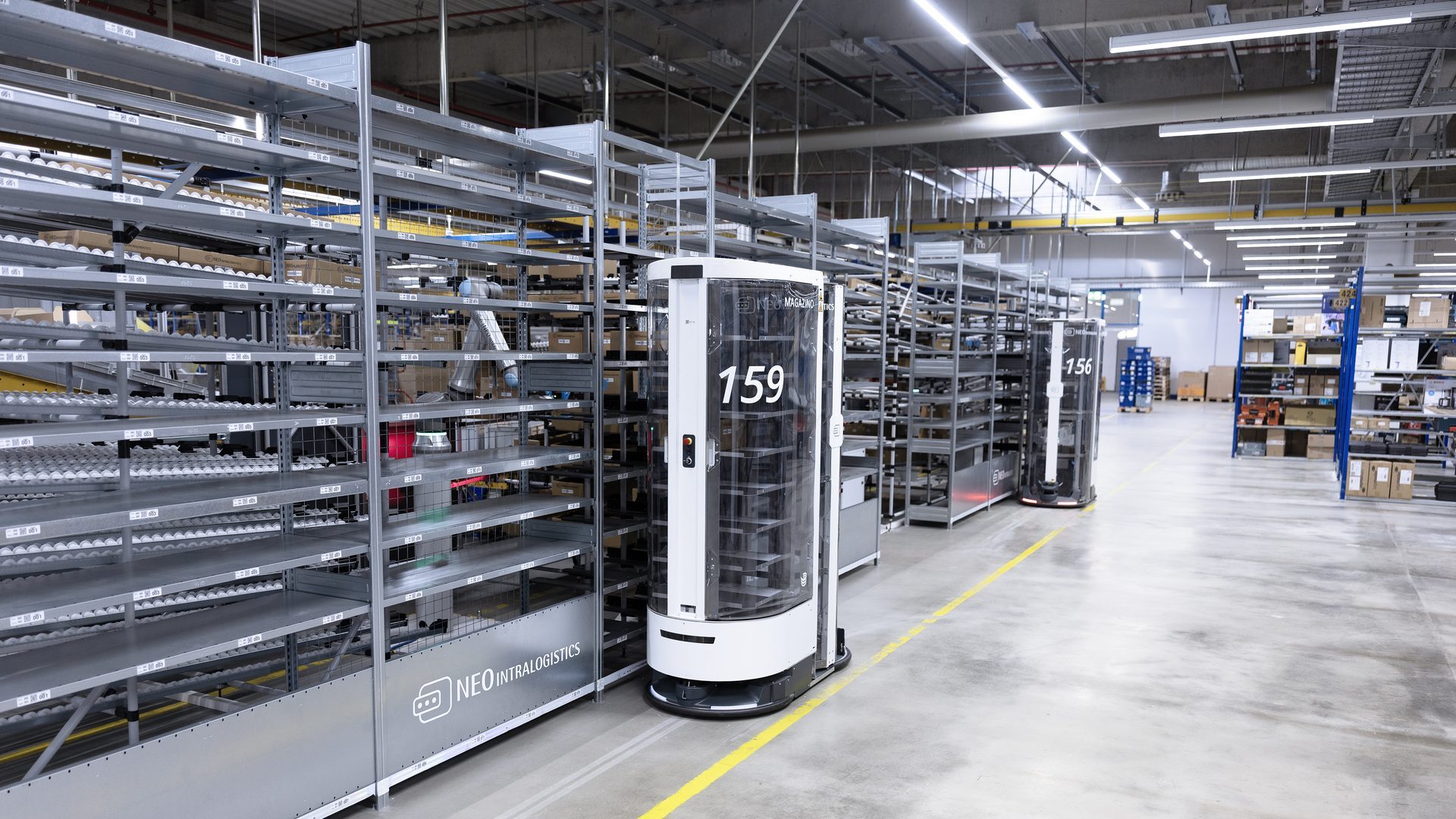
Wide warehouse view with robot fleet - scale comparison vs. cube-based AS/RS systems

What Is a Cube-Based AS/RS System?

A cube-based AS/RS system is an automated warehouse where robots travel on a grid above stacked storage bins. The robots lift bins from above and transport them to picking ports, where operators pick individual items.

Typical characteristics:

  • Cube grid: Bins are stacked in shafts - up to 6 meters deep. Robots on the roof of the cube reach down from above.
  • Extremely high storage density: Three-dimensional stacking provides significantly higher density than shelf-based racking or shuttle systems.
  • Only suitable for small, lightweight items: Standard bins, item weight typically below 30 kg.
  • Dedicated new build or major retrofit: The cube grid requires specific floor load capacity, ceiling height, and completely new warehouse infrastructure.
  • Investment: multi-million (often in the tens of millions), depending on size and throughput requirements.
  • Implementation: 12-36 months from planning to commissioning.

Known vendors: AutoStore (via system integrators), Jungheinrich PowerCube, GridStore.

AS/RS Context

Cube-based AS/RS systems are one of three AS/RS subtypes. The other two - crane-based mini-load systems (AKL) and shuttle systems - also require dedicated infrastructure. NEO is not an AS/RS variant - NEO automates existing shelf-based warehouses as a retrofit.

Crane-Based AS/RS (Mini-Load)

One stacker crane per aisle, optimized for deep, narrow aisles and tall warehouses. Highest throughput per aisle, but limited flexibility.

Shuttle-Based AS/RS

Independent shuttle vehicles per racking level, connected by lifts for level changes. More modular than crane-based systems and faster for multi-deep storage.

Cube-Based AS/RS Systems (e.g., AutoStore)

Robots on a grid above stacked bins. Highest storage density, but only suitable for small, lightweight items and new-build projects.

NEO:runner fleet in existing warehouse - scalable capacity without cube-based AS/RS investment

Investment and Financing

A cube-based AS/RS system ties up significant capital. The investment makes sense when stable, high volumes are plannable over decades. If your business faces fluctuations - seasonal peaks, growing or changing client portfolios - NEO’s pay-per-pick model shares the economic risk: less volume means lower costs.

NEO:runner fleet in existing shelf-based racking - no new cube infrastructure required

Building, Infrastructure and Capacity Planning

A cube-based AS/RS system requires completely new warehouse infrastructure: the cube grid must be built from scratch on a purpose-prepared foundation, placing specific demands on floor load capacity and ceiling height. In an existing warehouse, that typically means removing existing racking, building the cube foundation, and integrating picking ports and conveyor technology.

There is also a structural planning challenge: capacity must be defined before the system is built. Size it for average demand and the system breaks during peak season. Size it for peak demand and you pay for idle infrastructure eleven months a year. Either way, capacity is locked in before the first pick.

NEO breaks this trade-off through collaborative picking: robots and human pickers operate in the same warehouse and the same picking cycle. Size the robot fleet for average load - and add human pickers alongside the robots when seasonal demand spikes. No new infrastructure to build, no parallel manual operation to staff up. → How the retrofit works
Further Decision Criteria

Existing Building vs. New Construction

AS/RS systems require specific floor load capacity, ceiling height, and often climate conditions. If you have an existing warehouse - often with a lease, limited ceiling height, or multiple locations - you need a solution that adapts to your infrastructure, not the other way around.

Implementation Speed

From decision to first automated pick, NEO takes 6-8 weeks. A cube-based AS/RS system takes 12-36 months. If your competition is growing now or your labor costs are rising today, that time difference can be decisive.

Item Spectrum and Size

Cube-based AS/RS systems are optimized for small, standardized bins. NEO handles items up to 380 × 270 × 140 mm and 5 kg - covering the majority of typical e-commerce and spare parts assortments.

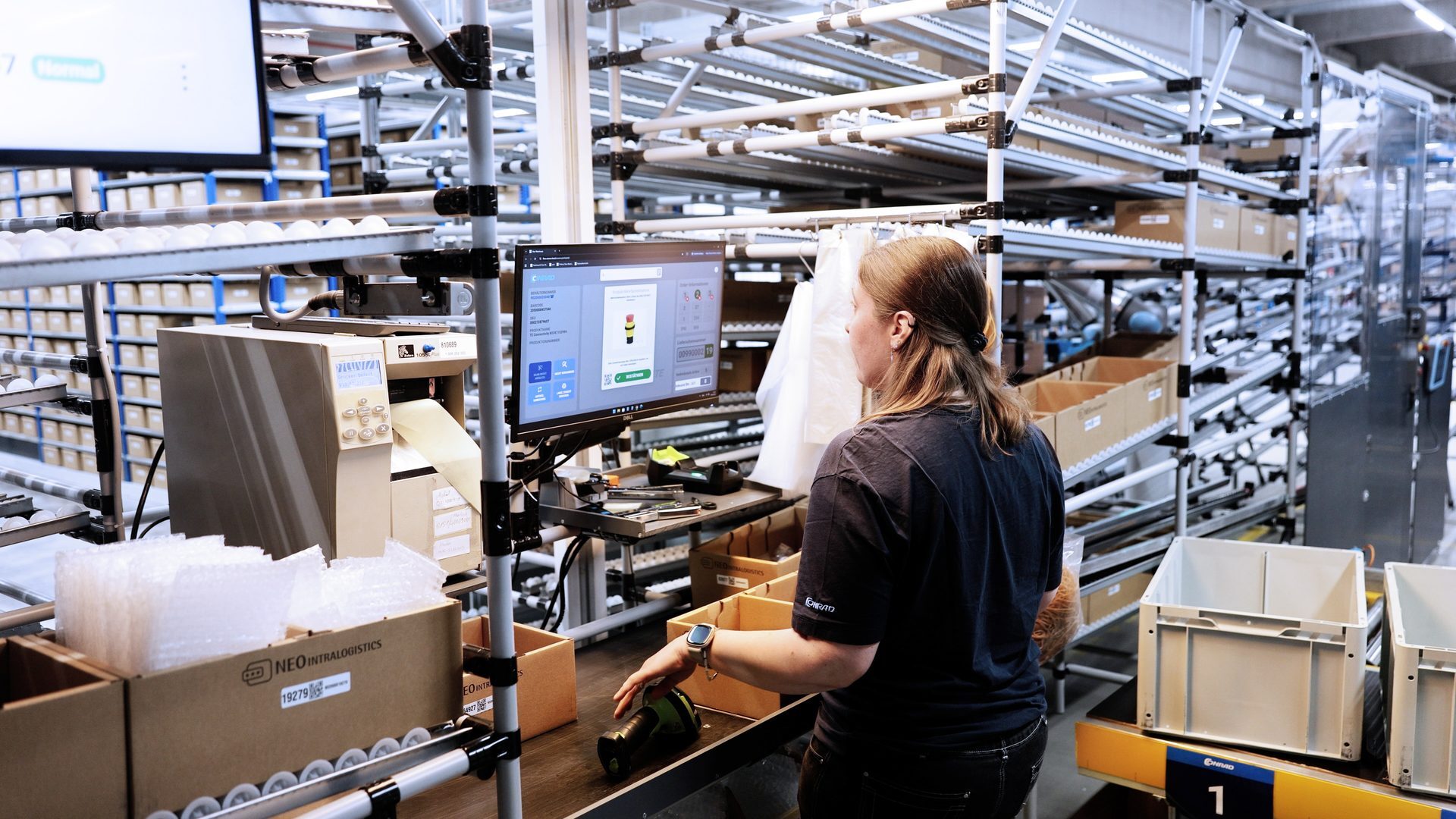
Operator at NEO:pickstation - flexible entry point before cube AS/RS investment

The Hybrid Path

Some companies use NEO as their entry point into automation - and invest in a cube-based AS/RS system later when volume and business case align. NEO ties up no capital and builds operational experience with automated picking. The pay-per-pick data from live operations simultaneously provides the reliable basis for a future cube investment decision - with real picks instead of projections.

Starting with NEO reduces the risk: no purpose-built facility, no multi-million budget - and still automated picking from week 6.

Who NEO Is the Better Choice For

Mid-Market Companies

Achieve automation without a multi-million investment.

3PL Operators

Serve changing clients and fluctuating volumes with flexibility.

Companies with Leased Warehouses

No structural modifications possible - NEO works within your existing infrastructure.

Fast Capacity Build-Up

Sites that need capacity before the next peak season.

Pilot-First Companies

Test first, then scale - a NEO pilot ties up zero capital.

Results at a Glance

6-8weeks
Time-to-value
0EUR
CapEx investment
12-36months
Cube-based AS/RS lead time
1station
Minimum start

FAQ

Is NEO an alternative to AutoStore?

NEO and AutoStore solve different problems. AutoStore is a cube-based AS/RS system for new-build projects with high storage density - ideal for greenfield sites with high volume and small items. NEO automates existing shelf-based warehouses without construction, without CapEx, and in 6-8 weeks. If you have an existing warehouse and cannot or do not want to invest in fixed infrastructure, NEO is the fitting alternative.

Can NEO achieve the same storage density as a cube-based AS/RS system?

No. Cube-based AS/RS systems like AutoStore achieve higher storage density per square meter because bins are stacked three-dimensionally. NEO increases the capacity of your existing shelving by a factor of 2-3 through densified storage - without requiring a new building. For many existing warehouses, this is the more economical path.

What happens if my volume grows beyond what NEO can handle?

NEO scales with your volume: more robots, more stations, more automated aisles. If you eventually reach volumes that justify a fully automated AS/RS, NEO can serve as a transition solution - you gain automation experience without tying up capital while you build the business case for a larger system.

What happens during Black Friday, holiday season, or other peak periods?

This is where NEO has a structural advantage through collaborative picking. A cube-based AS/RS forces a binary choice: size the cube for peak demand and pay for idle capacity most of the year, or size it for average and break during peak. With NEO, robots and human pickers operate in the same picking cycle. You size the robot fleet for average load - and add human pickers alongside the robots when seasonal demand spikes. Operational capacity tracks real demand without locking capital into infrastructure that only earns its keep a few weeks a year.

What item sizes does NEO handle?

NEO handles items up to 380 × 270 × 140 mm and a maximum of 5 kg. Aisle width must be at least 85 cm, shelf height no more than 250 cm. For items outside these parameters, we assess feasibility during the initial analysis.

How does NEO integrate with my existing WMS?

NEO:os, NEO’s software platform, integrates with your existing warehouse management system via standard interfaces. The orchestration software manages order routing between WMS, NEO:runner fleet, and picking station. → Learn more about the platform

Request a Fit-Check

Not sure whether NEO or a cube-based AS/RS system is the right solution for your warehouse? In a 30-minute call, we assess your infrastructure, item spectrum, and investment framework - honestly and vendor-independently.

Request a Fit-Check