Running out of warehouse space? The answer is not more square meters
Warehouse space across Europe is scarce, expensive, and getting harder to find. But for most operators, the real problem is not the size of the building - it is how much of the existing space is actually used for storage versus the space consumed by wide picking aisles, staging areas, and manual workflow zones. Unlocking 2-3x more storage capacity inside the same footprint is possible today - without construction, without CapEx, and without changing racking systems.
Ask any logistics operator in Germany, the Netherlands, or Austria about their biggest operational constraint, and the answer is increasingly the same: space. Not labor (though that is a close second), not technology - physical warehouse space.
The numbers confirm the pressure. Warehouse vacancy rates in major European logistics corridors have dropped below 3%. Prime logistics rents in Munich, Frankfurt, and Amsterdam have increased 30-50% since 2021. New construction has slowed due to rising interest rates, labor shortages in the construction sector, and tightening environmental regulations.
For operators who cannot secure additional space - or who cannot justify the cost - the question becomes: how do you get more capacity out of the building you already have?
Why warehouse space is getting tighter
E-commerce growth keeps raising the bar
Online retail requires fundamentally more warehouse space than traditional brick-and-mortar distribution. A physical store holds its own inventory; an e-commerce fulfillment center holds inventory for thousands of individual shipments daily. The growth of same-day and next-day delivery has intensified this further by requiring more regional distribution points closer to end customers.
The result: demand for warehouse space has grown faster than supply for six consecutive years.
Urban and peri-urban land is running out
The most valuable warehouse locations - close to population centers and transportation hubs - are also the most constrained. Competition with residential, commercial, and industrial development means that new logistics sites near major cities are increasingly rare and prohibitively expensive.
Operators who secured leases on peri-urban sites five or ten years ago now face renewal negotiations at dramatically higher rates - if the site is not being converted to other uses entirely.
New construction is slow and expensive
Even when suitable land is available, building a new warehouse takes 18-36 months and requires CapEx in the range of EUR 800-2,000 per square meter - before any automation or racking is installed. Rising construction costs, permitting delays, and environmental impact assessments have extended timelines further.
For operators who need more capacity in the next 6-12 months, new construction is not a solution. It is a multi-year capital project.
The hidden capacity inside existing warehouses
Here is what most operators overlook: the typical manually operated Fachbodenregal warehouse uses only 40-50% of its theoretical storage capacity. The rest is consumed by:
- Wide picking aisles: Manual picking requires aisles wide enough for pickers with carts or trolleys - typically 2.5-3.5 meters. That aisle space stores nothing.
- Staging and buffer zones: Manual workflows require areas for order consolidation, cart parking, and pre-sorting that automated workflows eliminate.
- Accessibility constraints: In manual warehouses, every shelf position must be reachable by a human picker. This limits vertical storage density and prevents the use of high-density slotting strategies.
- Safety margins: Forklift traffic, crossing points, and fire escape routes consume additional floor area.
The practical consequence: a 5,000 sqm warehouse operating at 45% storage density holds the same inventory as a 2,500 sqm warehouse operating at 90% density. The capacity problem is not about square meters - it is about how effectively those square meters are used.
How automation unlocks 2-3x more storage capacity
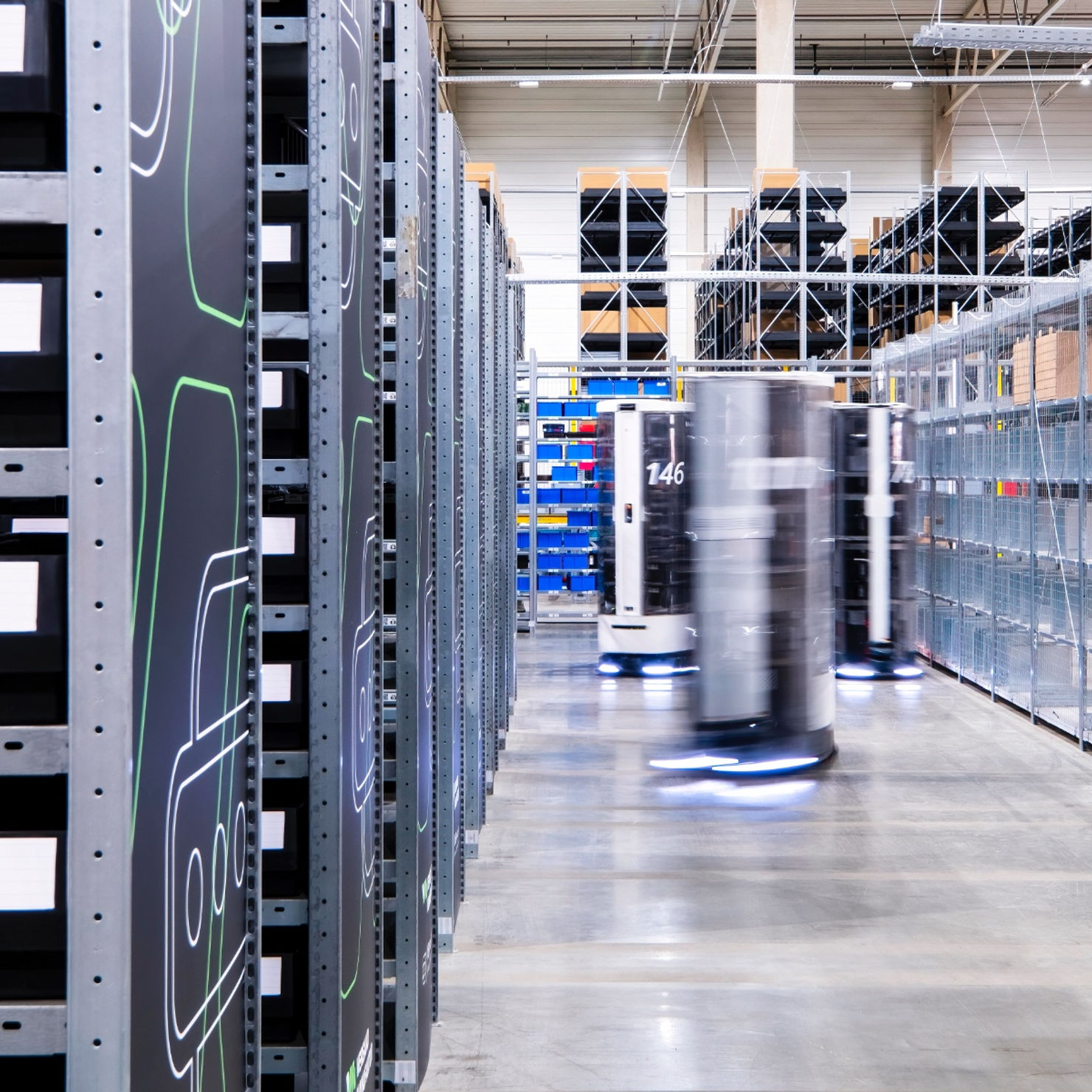
AMR-based goods-to-person systems like NEO's platform fundamentally change the warehouse space equation by eliminating the need for human access to every shelf position.
Narrower aisles
When robots - not people - navigate the aisles, aisle width requirements drop significantly. Shelving rows can be placed closer together, converting aisle space into storage space.
Elimination of manual workflow zones
Goods-to-person picking means that items come to the picker at a stationary workstation. The staging areas, cart parking zones, and pre-sorting buffers required by manual picking are eliminated.
Better vertical utilization
Robots can access shelf positions that are impractical or unsafe for human pickers, enabling more effective use of vertical space without requiring mezzanine structures.
Dynamic slotting
NEO:os continuously optimizes product placement based on actual order patterns. Fast-moving SKUs are positioned for maximum retrieval efficiency; slow-movers occupy high-density positions that would be inconvenient for manual access.
The combined effect: operators typically see a 2-3x increase in effective storage capacity inside the same building, using the same shelving. No construction, no racking replacement, no expansion.
The cost of not solving the space problem
Warehouse space shortage is not just an operational inconvenience. It has direct financial and strategic consequences:
Rising rent erodes margins
When warehouse rents increase 30-50% at lease renewal, that cost flows directly to the bottom line. For operators already running on thin fulfillment margins, this can make entire customer accounts unprofitable.
Capacity constraints limit growth
If the warehouse is full, new customers cannot be onboarded and existing customers cannot grow their product range. The warehouse labor shortage makes this worse: even if space were available, there may not be enough pickers to work it.
Suboptimal locations create inefficiency
When operators are forced to lease secondary warehouse space in less convenient locations, transportation costs increase, delivery times lengthen, and split-site operations add management complexity.
Competitive disadvantage
Competitors who solve the space problem - through automation or smarter capacity utilization - can offer faster delivery, broader product selection, and lower fulfillment costs. The gap widens over time.
Why traditional automation does not solve the space problem for most operators
It might seem like any automation technology would improve space utilization. But for operators in existing buildings, the reality is more nuanced.
According to NEO's 2026 whitepaper on warehouse automation architectures:
- AS/RS achieves excellent storage density - but requires purpose-built high-bay structures. Installing AS/RS in an existing Fachbodenregal warehouse means demolishing the current interior.
- Cube-based storage (AutoStore) is space-efficient but requires removing all existing shelving and replacing it with a proprietary grid. CapEx ranges from EUR 1-5 million.
- Shuttle systems offer moderate density improvements but require custom racking and 12-18 months of implementation.
All three approaches solve the density problem by replacing the existing warehouse infrastructure. For operators who need more capacity from their current shelving - without construction, without CapEx, and without 12+ months of waiting - these are not viable paths.
AMR-based retrofit automation is the only approach that increases storage density inside existing Fachbodenregal, in the existing building, without removing or replacing shelving.
Real-world capacity improvements
Enterprise electronics retailer
After deploying NEO's AMR system into their existing shelf-racking warehouse, a leading European electronics retailer achieved a significant increase in storage density by narrowing aisles and eliminating manual workflow zones - all without construction or racking changes.
3PL fulfillment operator
A major 3PL fulfillment operator scaled their NEO deployment from a pilot zone to full warehouse coverage, unlocking additional storage capacity at each phase. The incremental approach meant that capacity improvements were realized progressively - without the all-or-nothing commitment of a traditional automation project.
A practical framework for capacity optimization
For operators facing warehouse space constraints, here is a structured approach:
- Measure current density: Calculate the ratio of actual storage positions used to theoretical maximum. Most manual warehouses operate at 40-50%.
- Identify space consumers: Map aisle widths, staging zones, buffer areas, and underutilized vertical space. These are the targets for densification.
- Evaluate automation fit: Determine whether the warehouse uses standard Fachbodenregal (if so, AMR retrofit is viable) or requires specialized racking.
- Start with a pilot zone: Deploy automation in a single section to validate density improvements before committing to full rollout.
- Measure and expand: Compare density, throughput, and cost metrics against the manual baseline. Scale based on data, not projections.
NEO's pilot-first approach follows this exact framework. Operators validate capacity improvements in weeks, not months.
Frequently Asked Questions
How much additional storage capacity can automation unlock?
AMR-based goods-to-person systems typically unlock 2-3x more storage capacity inside existing warehouses. The improvement comes from narrower aisles, elimination of manual workflow zones, and better vertical utilization - all without construction or racking changes.
Can you increase warehouse capacity without building a new facility?
Yes. The majority of manually operated warehouses use only 40-50% of their theoretical storage capacity. Automating the picking process with AMR robots enables tighter shelving placement, removes staging zones, and improves vertical space utilization - unlocking significant additional capacity without expanding the building footprint.
How long does it take to increase warehouse storage density with automation?
With AMR-based retrofit automation, operators can see capacity improvements within 6-8 weeks of deployment. Traditional automation approaches (AS/RS, shuttle, cube storage) require 6-18 months and typically involve construction work.
Is increasing storage density expensive?
NEO's AMR solution operates on a pay-per-pick model with near-zero upfront cost. Operators pay per automated pick rather than financing a multi-million-euro installation. Traditional storage density solutions (AS/RS, cube storage) require EUR 2-10M+ in CapEx.
What types of warehouses can benefit from capacity optimization?
Any warehouse using standard shelf racking (Fachbodenregal) with manual picking processes is a candidate. This includes e-commerce fulfillment, spare parts distribution, pharmaceutical logistics, and general merchandise warehousing. Warehouses handling only full pallets (no piece-picking) are typically not suitable for AMR-based optimization.
Ready to see it in action?
Stop searching for space you do not need. Book a live demo and see how NEO unlocks 2-3x more storage capacity inside your existing warehouse - with no construction, no CapEx, and go-live in 6-8 weeks.